

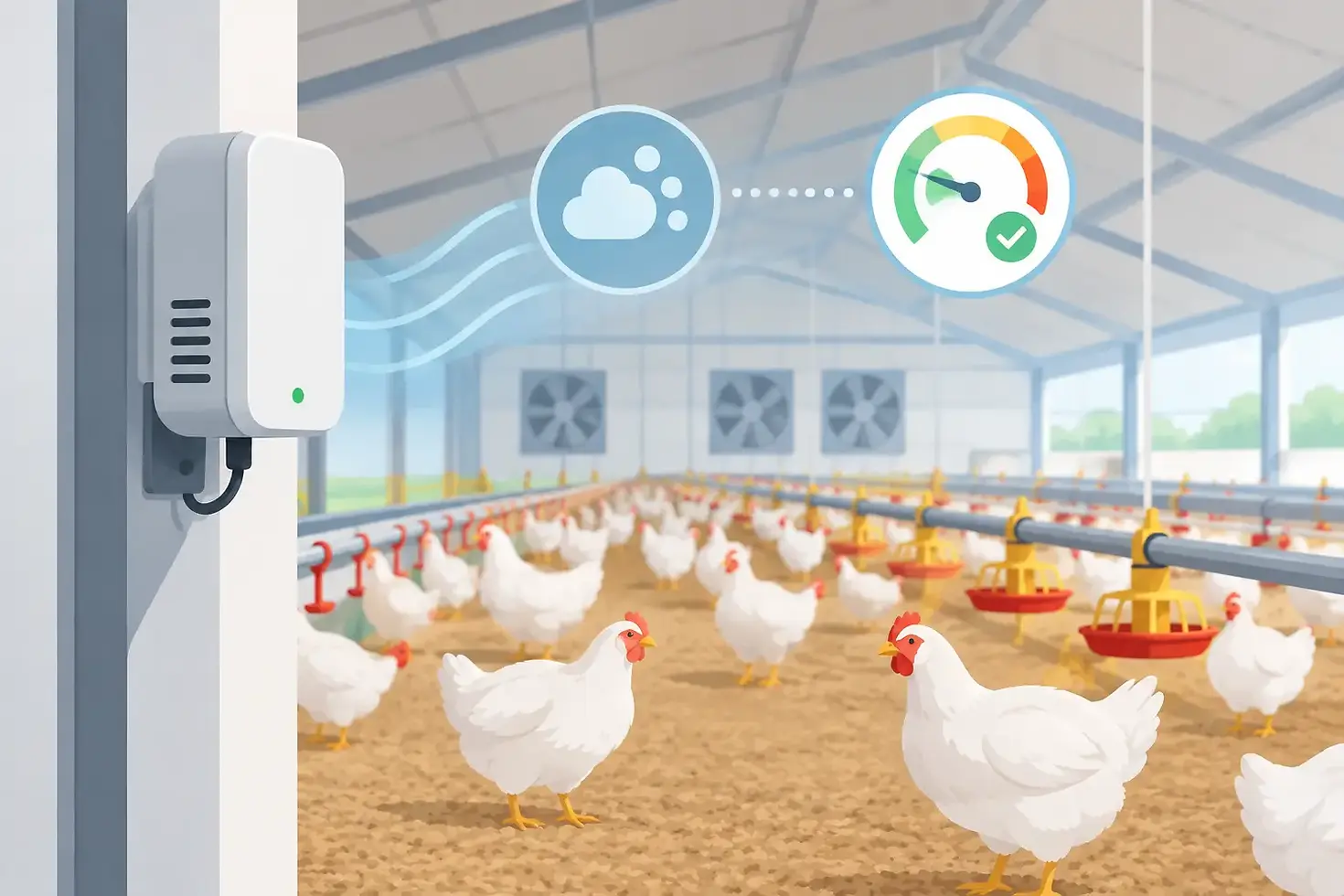
How Accurate Are CO2 Sensors in Poultry Houses?
A CO2 reading of 3,000 ppm can trigger a ventilation decision that affects bird comfort, fuel use, litter condition, and performance. That makes the question, how accurate are CO2 sensors, more than a specification-sheet exercise. In a poultry or pig house, the useful answer is not one number. It depends on the sensing technology, the stated tolerance, installation location, maintenance condition, and how the controller uses the signal.
A quality agricultural CO2 sensor can provide dependable measurements for ventilation control. But the sensor is only one part of the measurement system. A properly specified sensor installed in the wrong location can deliver a technically valid reading that does not represent the air the animals are breathing.
How Accurate Are CO2 Sensors Under Farm Conditions?
Most modern barn CO2 sensors use non-dispersive infrared technology, commonly called NDIR. Carbon dioxide absorbs infrared light at known wavelengths. The sensor measures this absorption and converts it to a concentration, normally displayed in parts per million, or ppm.
For a fixed NDIR CO2 sensor used in livestock climate control, a typical accuracy specification may fall around ±50 ppm plus 3% to 5% of the reading, depending on the sensor range and manufacturer. At 3,000 ppm, a 5% reading tolerance equals 150 ppm. Combined with a fixed tolerance, the indicated value may reasonably differ from a reference value by roughly 200 ppm or more.
That does not mean the sensor is unreliable. It means accuracy must be understood in context. For ventilation control, a stable, repeatable sensor that correctly identifies rising CO2 is often more valuable than a laboratory-grade instrument that is poorly integrated into the house control system. The controller needs a signal it can use consistently to stage fans, manage minimum ventilation, and provide alarms.
Sensor accuracy is also different from resolution. A display may show changes of 1 ppm, but that does not mean the sensor is accurate to 1 ppm. Resolution describes the smallest displayed increment. Accuracy describes how close the measurement is likely to be to the actual gas concentration.
The Difference Between Sensor Accuracy and Control Accuracy
A CO2 sensor specification is measured under defined test conditions. Poultry houses are not defined test conditions. Dust, humidity, temperature shifts, bird activity, heater operation, air speed, washdown practices, and uneven ventilation all affect the final control result.
Control accuracy starts with the sensor, but it also includes signal wiring or communication quality, controller scaling, setpoint configuration, fan capacity, inlet performance, and the sensor's physical location. If a sensor is mounted near a heater, fresh-air inlet, exhaust fan, or service door, its reading may accurately describe that local air pocket while failing to represent the occupied zone.
This is why a CO2 measurement should not be treated as an isolated number. It is one input within the house environment. Temperature, relative humidity, static pressure, ammonia risk, litter condition, and bird behavior should support the same operational picture. If CO2 rises while humidity and static pressure behavior indicate reduced air exchange, the ventilation response is easier to validate. If one signal disagrees with every other condition, investigate before changing a control strategy.
Accuracy at Low and High CO2 Levels
Outdoor air is commonly near 400 to 500 ppm CO2, although local conditions vary. Inside a closed or minimally ventilated house, concentrations increase as birds respire and combustion equipment operates. During cold weather, minimum ventilation settings are often the period when CO2 monitoring has the greatest value.
A sensor's percentage-of-reading error becomes more significant as concentration rises. A sensor reading 1,000 ppm and a sensor reading 4,000 ppm may have different absolute tolerances even when both meet the same percentage specification. Technical buyers should review the accuracy statement across the range that matters for their operation, not only the sensor's maximum measurable range.
A wide measurement range does not automatically deliver the best accuracy at the concentrations used for poultry ventilation. Select a sensor range and specification that fit the expected control range, then confirm the controller can display, alarm, and act on the signal at useful intervals.
What Reduces CO2 Sensor Accuracy in a Barn?
The most common accuracy problems are not caused by NDIR technology itself. They are caused by exposure and installation. Livestock buildings place sensors in a demanding environment, so farm-ready housing and planned service access matter.
Dust can block air exchange into the sensing chamber or contaminate filters and protective surfaces. High humidity and condensation can interfere with measurements or damage electronics if the enclosure is not suited to the location. Temperature changes influence infrared measurement behavior, which is why quality sensors use temperature compensation. Compensation improves performance, but it does not remove the need to keep the sensor away from direct heat sources and abrupt drafts.
Placement has an equally large effect. Mount the sensor where it represents the animal environment, generally within the occupied-zone air pattern but protected from direct contact, water spray, and physical damage. Avoid locations directly in the path of incoming cold air, directly above brooders or heaters, immediately beside exhaust points, and in stagnant corners. The correct mounting height and position will vary with bird age, house design, ventilation system, and whether the facility uses floor production, cages, or other equipment layouts.
For large houses, one sensor may not represent every area equally. Long houses, separated zones, or facilities with known airflow differences may require multiple measurement points or a control strategy that recognizes the critical zone. A single average value can conceal a local ventilation problem.
Calibration, Drift, and Verification
All sensors can drift over time. Drift is a gradual shift between the reported value and the true concentration. The rate depends on sensor design, environmental exposure, operating hours, and maintenance practices.
Some CO2 sensors use automatic baseline correction. This function assumes the sensor periodically sees fresh outdoor air and uses that condition to correct its baseline. It can be effective in applications with regular ventilation cycles. It may be less suitable where a sensor remains continuously exposed to elevated CO2 or where the assumed fresh-air baseline is rarely reached. Automatic correction should match the operating conditions of the barn, not simply be accepted as a default setting.
A practical verification program compares the installed sensor with a recently calibrated reference instrument at the same location. Allow both instruments to stabilize in the air stream before comparing values. A brief side-by-side check at the controller cabinet or in the office is not enough if the installed sensor normally operates in the house.
When the difference exceeds the expected combined tolerance, first inspect the installation, sensor openings, filters, wiring, power supply, and controller configuration. Then follow the sensor manufacturer's calibration or replacement procedure. Do not force an offset into the controller without confirming that the reference device is suitable and that the discrepancy is not caused by placement.
Using CO2 Readings for Better Ventilation Decisions
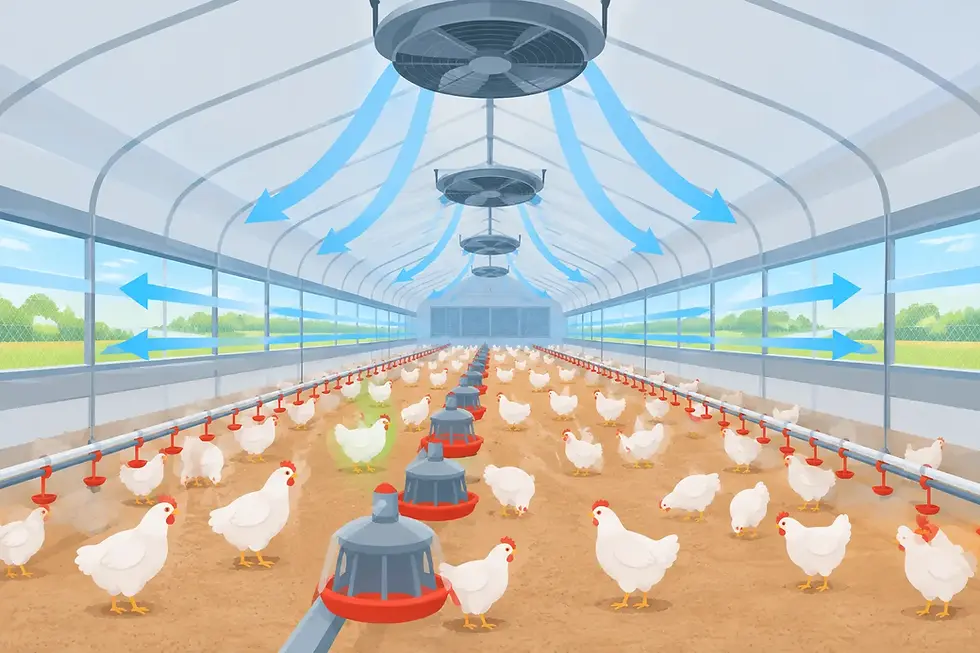
CO2 should support minimum ventilation control, not replace sound ventilation design. In cold weather, producers often reduce airflow to conserve heat. If airflow falls too far, CO2, moisture, and other contaminants accumulate. The cost of saving fuel can become poor air quality, wet litter, and reduced flock conditions.
A properly integrated sensor allows the climate controller to respond to conditions instead of relying only on a fixed timer cycle. For example, CO2 can be used as a limit or corrective input when minimum ventilation does not provide enough air exchange. This approach requires careful setup. An aggressive response may increase heating demand and create drafts. A slow response can allow prolonged poor air quality.
Setpoints should be developed for the production system, season, bird age, equipment capacity, and company standards. They should also be validated against real house conditions. A reading that trends upward every morning, follows heater operation, or varies sharply between zones provides useful operational information even before an alarm threshold is reached.
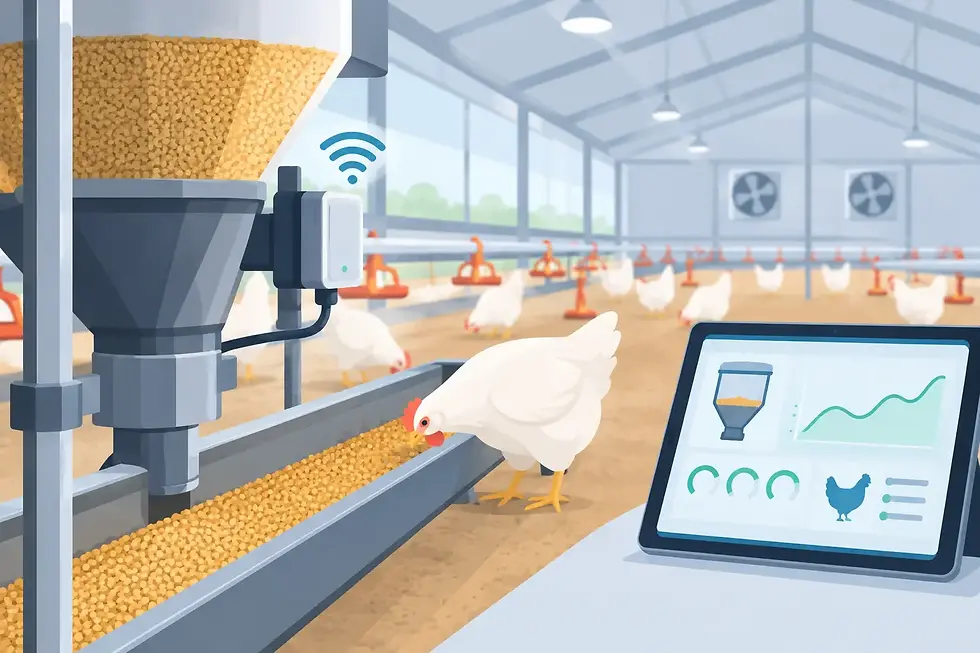
Integrated controllers such as the Agromatic Columbus AGM platform can bring CO2 signals together with temperature, humidity, static pressure, fan stages, alarms, and remote access. The value is not simply seeing a CO2 number on a screen. It is using one dependable signal within a connected control strategy that makes ventilation performance visible and actionable.
Selecting a CO2 Sensor for Livestock Housing
When comparing sensors, start with the stated accuracy at the concentrations expected inside the house. Then review repeatability, response time, operating temperature and humidity limits, enclosure protection, output type, calibration method, and maintenance requirements. Confirm compatibility with the controller input, whether analog or digital, and verify that the controller preserves the sensor's useful measurement resolution.
Serviceability matters. A sensor that requires periodic inspection should be accessible without interrupting normal house operation or placing personnel in an unsafe location. Replacement procedures, spare-part availability, and clear diagnostic information reduce downtime when a fault occurs.
The most accurate CO2 sensor is not always the best choice if it is not designed for dust, humidity, temperature variation, and continuous agricultural duty. For commercial livestock facilities, a durable sensor with known performance, correct placement, and scheduled verification will usually deliver better control than a higher-specification device treated as maintenance-free.
CO2 data earns its value when it leads to a better ventilation decision. Install the sensor where the reading represents the animals, verify it against a trusted reference, and review its trend alongside the rest of the house environment. That is how a measurement becomes useful control.
Comments