

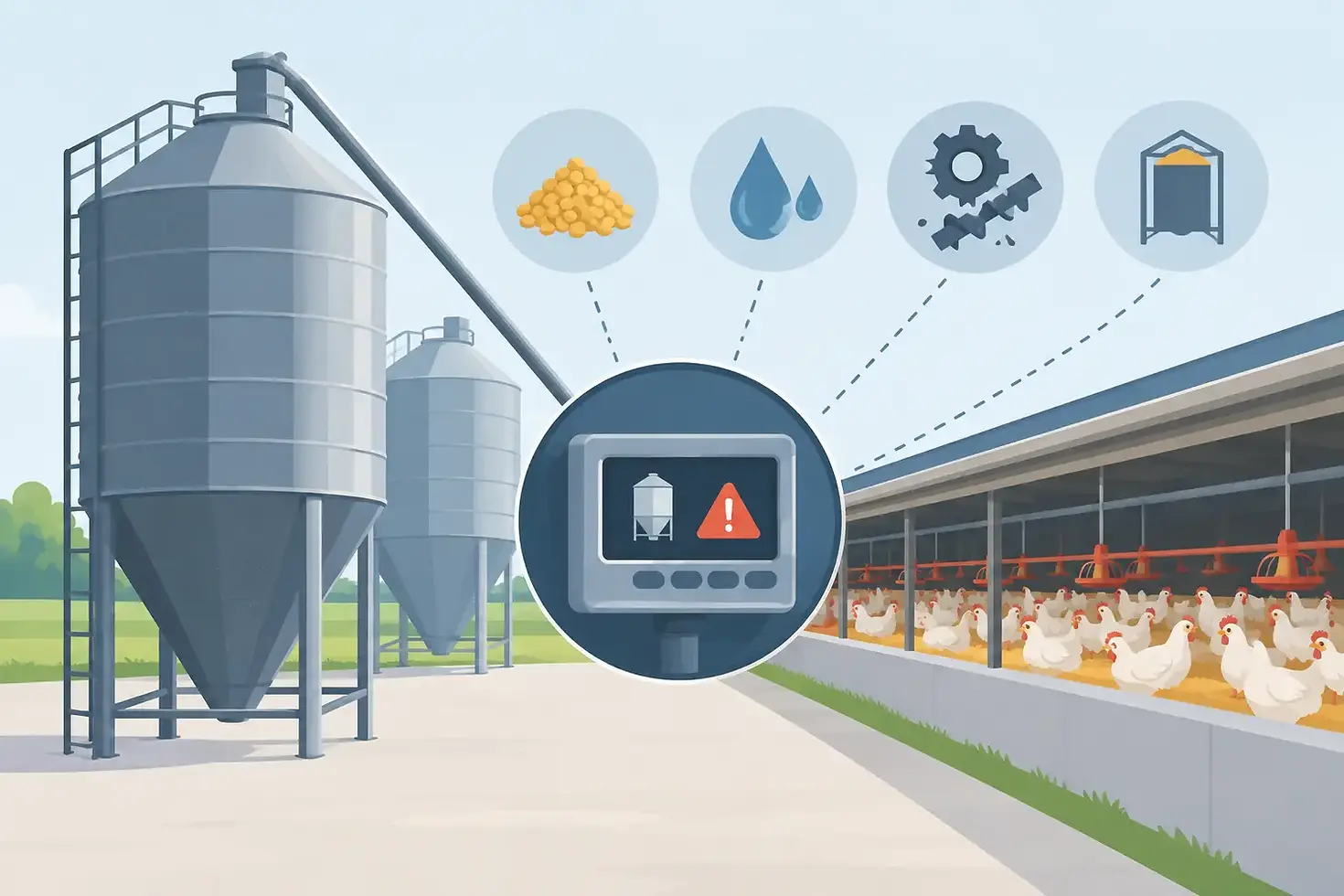
What Causes Silo Weight Errors in Poultry Houses?
A silo reading that does not match delivered feed is more than a bookkeeping issue. It can hide feed waste, distort feed conversion calculations, trigger incorrect purchasing decisions, and make it harder to identify a mechanical feed-system problem. Understanding what causes silo weight errors helps poultry and livestock managers separate a true inventory change from a measurement fault before the discrepancy affects production decisions.
A silo weighing system is straightforward in principle: load cells measure the force carried by the silo structure, and the indicator or controller converts that signal into a weight. In practice, the measurement is affected by every mechanical connection, electrical signal path, and operating condition around the silo. The most reliable troubleshooting starts with the physical installation, then moves to the load cells, wiring, calibration, and feed-management process.
What Causes Silo Weight Errors Most Often?
The most common cause is restricted movement. A weighing silo must transfer its full load through the load cells while remaining free to move slightly as weight changes. If part of the structure is touching or pulling against something else, the load cells no longer see the complete and consistent load.
This restriction may be obvious, such as a silo leg resting on a concrete ledge, or subtle, such as a rigid discharge pipe, auger support, catwalk, ladder, or electrical conduit carrying some of the silo weight. Snow buildup, accumulated feed around a base area, and a brace installed after the original scale system can produce the same result. A system may appear accurate at one fill level but drift as the silo expands, settles, or shifts under a changing load.
Mechanical binding usually produces readings that are unstable, slow to return after feed use, or inconsistent between fill and empty conditions. Before changing calibration values, inspect every point where the silo, hopper, auger, transitions, and support structure connect to fixed equipment. Calibration cannot correct a silo that is not mechanically free.
Load-cell damage and uneven loading
Load cells are designed for the specific capacity, mounting arrangement, and environmental conditions of the silo. Overloading during feed delivery, impact from equipment, corrosion, lightning-related electrical events, or excessive side loading can damage a load cell without causing a complete signal failure. The system will still display weight, but the value may become inaccurate or shift over time.
Uneven loading is also a concern. A silo does not always fill symmetrically, particularly when delivery feed enters through an offset fill pipe or bridges along one side of the cone. Good scale electronics can show the total mass accurately when the structural load path is correct, but an individual damaged or obstructed load cell can respond differently as the feed mass moves. Comparing individual load-cell readings, where the indicator supports this function, is one of the fastest ways to find an abnormal support point.
Inspect mounting hardware for bent components, loose bolts, damaged check rods, blocked rocker assemblies, and corrosion around the load-cell feet. Check rods are especially important because they control horizontal movement while allowing the vertical movement required for accurate weighing. If they are overtightened or incorrectly adjusted, they can introduce side forces and create repeatable errors.
Feed Behavior Can Look Like a Weight Error
Not every difference between expected feed inventory and displayed silo weight is an instrument failure. Feed can bridge, rat-hole, compact, or hang in the cone, especially when moisture, fines, pellet quality, storage time, and feed formulation create poor flow conditions. In this situation, the weighing system may accurately report the total feed remaining in the silo while the feed line receives less material than expected. The reverse can also occur when a bridge breaks loose and a large amount of retained feed suddenly enters the system.
Moisture is a frequent contributor. Wet feed can adhere to walls and cone surfaces, while high humidity and condensation can change material flow behavior. A roof leak or poorly sealed fill cap can add material weight and cause feed quality issues at the same time. If readings change after rain, temperature swings, or a specific delivery event, inspect the silo exterior and interior condition before assuming the load cells are at fault.
The operating comparison matters. A feeder runtime estimate, bin level sensor, delivery ticket, and silo scale do not measure the same thing. Runtime estimates assume a consistent feed delivery rate. Level sensors show a point level, not inventory. Delivery tickets may include material loss, residual feed in the truck, or documentation errors. The silo scale is generally the strongest inventory reference when it is installed and maintained correctly, but its result should be checked against known deliveries and controlled feed-out events.
Electrical Causes of Silo Weight Errors
Load cells produce a low-level electrical signal. Damaged cable, water intrusion, poor grounding, loose terminals, and electrical noise can therefore create readings that jump, drift, or disappear intermittently. Rodent damage and abrasion at conduit entries are common field issues, particularly where cables are exposed near augers and service areas.
Moisture inside a junction box can change signal resistance and create seasonal problems. A system may perform normally during dry weather, then show unstable readings during periods of rain or washdown. Check all cable glands, junction-box gaskets, drain paths, and terminal connections. Do not simply dry a wet enclosure and close it again. The entry point must be corrected or the problem will return.
Grounding and power quality also deserve attention. Variable-speed drives, auger motors, welders, and other high-current equipment can introduce electrical interference when signal cables are poorly routed or shielding is incorrectly terminated. A weight indicator should have a stable power source and a grounding arrangement that follows the equipment manufacturer's installation requirements. Improvised grounds and shared neutral issues can create difficult-to-trace measurement problems.
Temperature can affect both the load-cell signal and the mechanical structure. Quality load cells compensate for normal temperature changes, but direct sun on one side of a silo, frozen material around supports, or large seasonal movement in connected piping can still influence the overall system. A recurring morning-versus-afternoon difference points to an environmental or mechanical effect worth investigating.
Calibration Errors and Zero Drift
A calibration error often begins after service work, controller replacement, accidental parameter changes, or an attempt to correct a discrepancy without a verified test load. Zeroing a silo that still contains feed is particularly risky. It makes the current display look correct only by hiding the actual residual weight, and every inventory calculation afterward will carry that offset.
Calibration should use a known, traceable load or a controlled material test with a documented weight. A delivery ticket alone can be useful for verification, but it is not always a precise calibration standard. Truck scale differences, partial loads, and feed remaining in delivery equipment all affect the comparison. The goal is to validate both zero stability and span accuracy across a meaningful portion of the silo capacity.
A properly configured controller should also retain clear records of weight changes, deliveries, alarms, and feed consumption. Connected farm control platforms, including Agromatic systems configured for feed monitoring, can make trends visible across houses and help identify when a deviation began. Data does not replace inspection, but it narrows the investigation from a vague inventory concern to a specific time, event, or silo.
A Practical Troubleshooting Sequence
Start by confirming the symptom. Determine whether the displayed weight is stable but wrong, drifting slowly, jumping intermittently, or failing to change when feed is used. Each pattern points toward a different cause. A stable offset suggests zero or calibration issues; an erratic reading suggests wiring, moisture, or interference; poor response to feed use often indicates binding or retained feed.
Next, inspect the silo mechanically with the system unloaded only when site procedures allow it. Look for contact points, packed material, tight piping, altered bracing, and damaged load-cell mounts. Then examine junction boxes, cables, connectors, and grounding. After physical and electrical faults are corrected, verify zero and calibration with a known reference. Changing parameters before these steps can mask the root cause and make later diagnosis more difficult.
For high-use poultry houses, establish a routine check after feed deliveries, seasonal temperature changes, major maintenance, and any equipment impact near the silo. Record the expected delivery amount, scale increase, and any observed feed-flow issue. A small, consistent verification process prevents a minor shift from becoming weeks of unreliable inventory data.
Accurate silo weight is not just a scale specification. It depends on free mechanical movement, protected signal wiring, controlled calibration, and feed that flows as expected. When those conditions are maintained, the weight reading becomes a practical management signal that supports tighter feed control and faster decisions at the house level.


Comments