

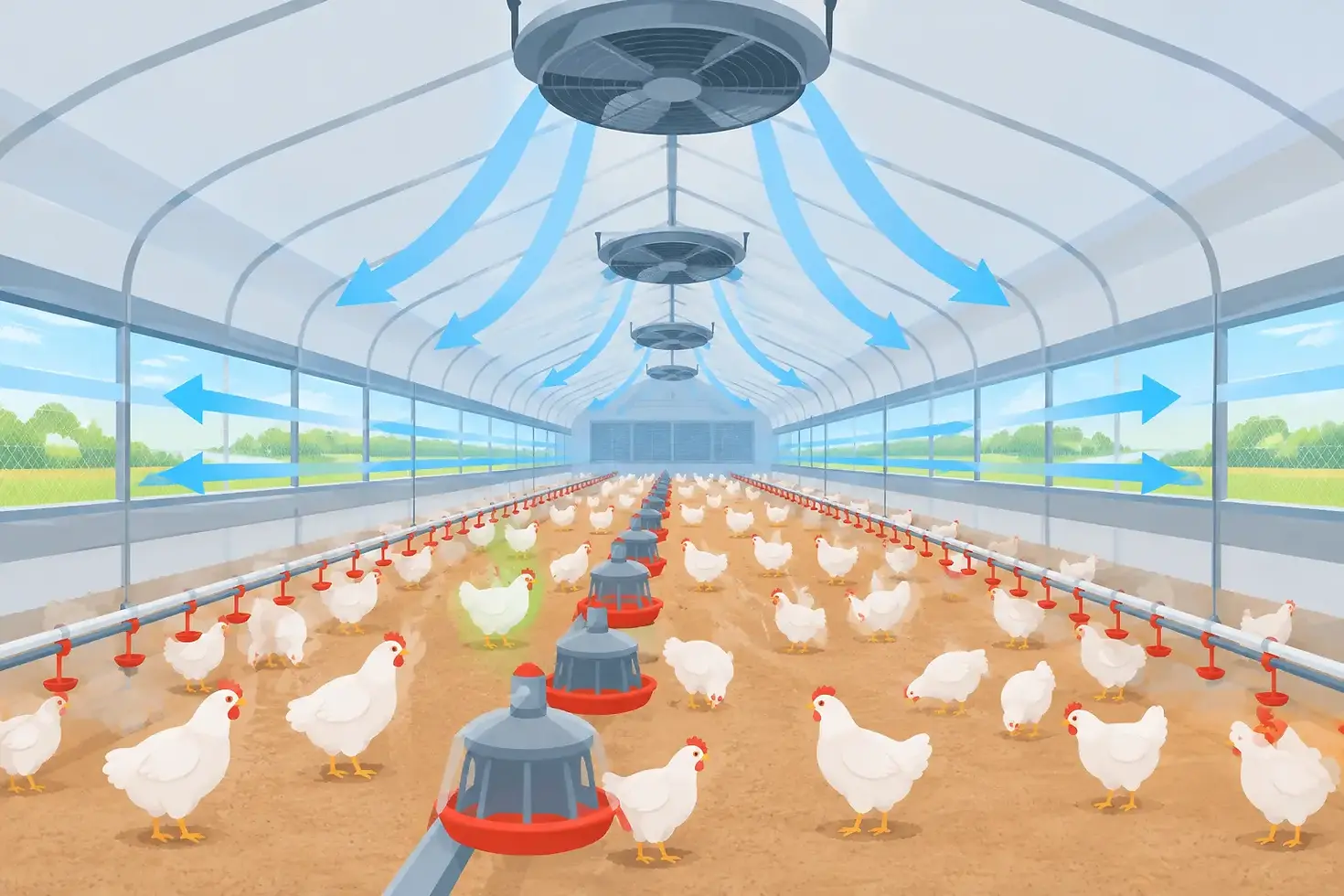
How to Optimize Tunnel Ventilation in Poultry
Tunnel ventilation can look correct on a controller screen while birds at the far end of the house are still under heat stress. To optimize tunnel ventilation, producers need to manage the complete air path - fan capacity, inlet area, static pressure, evaporative cooling, sensor placement, and control staging - as one operating system.
For broilers, pullets, turkeys, breeders, and cage-layer houses, the objective is not simply to run more fans. The objective is to create reliable air speed through the occupied zone, remove heat and moisture, and maintain conditions that are as uniform as practical from pad end to fan end. That requires measured performance, not assumptions based on installed equipment.
How to Optimize Tunnel Ventilation for Real Airflow
Tunnel mode works by drawing air through evaporative cooling pads or tunnel inlets and exhausting it through fans at the opposite end of the building. The resulting air velocity provides wind-chill benefit to the birds. If any part of that path is undersized, obstructed, leaking, or poorly controlled, house performance changes quickly.
Start with the design airflow requirement. Required airflow depends on house width and length, ceiling height, bird type, bird age, stocking density, insulation, local climate, and the air-speed target. A common target for mature broilers is often in the range of 400 to 600 feet per minute across the bird area, but the right value depends on the house and production program. Younger birds require lower air speed and different staging than market-age birds.
Installed fan count alone does not establish capacity. Fan performance must be considered at the static pressure the house actually operates under. Dirty shutters, worn belts, loose fan cones, damaged blades, clogged guards, and poor maintenance can reduce delivered airflow. A ventilation plan based on nameplate capacity can therefore overstate the air exchange available during the hottest part of the day.
Confirm the air path before changing setpoints
Before adjusting controller settings, inspect the physical system. Check that tunnel doors open fully, curtains seal correctly, pad frames do not admit uncontrolled bypass air, and fan shutters operate without restriction. Air leaks around end doors, sidewall inlets, damaged curtains, and unsealed service openings reduce negative pressure and make it harder to pull air evenly through the intended inlet area.
Static pressure is a useful operating measurement because it shows how hard the fans are pulling against the building and inlet system. Too little pressure may indicate excessive inlet area or leakage, which can reduce air direction and velocity. Too much pressure can restrict fan output and create uneven incoming air. The acceptable range depends on the house design, pad system, and selected equipment, so pressure should be evaluated against the system design rather than treated as a universal number.
A static pressure sensor should be installed in a representative location, protected from direct drafts and maintained as a measurement device rather than an afterthought. If pressure readings drift or fail, the controller loses a key input for managing ventilation consistency.
Match Fans, Inlets, and Cooling Capacity
Tunnel ventilation is limited by the weakest component. Adding fans may increase electrical demand without producing the expected air speed if inlet or pad area is inadequate. Increasing pad area without verifying water distribution and pump performance can create dry sections that allow hot untreated air into the house.
Evaporative pads should be sized to allow the required airflow at a reasonable face velocity. If air moves too quickly through the pad, cooling efficiency drops and water can be pulled into the house. If pad area is excessive or poorly managed, the system can add more humidity than the birds and local weather conditions can tolerate. Cooling pads reduce incoming dry-bulb temperature, but they also raise relative humidity. During humid weather, the benefit of additional pad operation may be limited.
Water management matters just as much as pad surface area. Verify that water reaches the full pad length, distribution headers are clean, sump levels are correct, and recirculation pumps deliver consistent flow. Scale, algae, mineral deposits, and damaged pad media reduce cooling performance and can create uneven temperature patterns along the house.
Use staged pad operation where the controller and cooling system support it. Initial cooling stages can reduce temperature without operating the full pad bank, while later stages respond to higher heat load. This approach can reduce unnecessary water use and help avoid overcooling during changing outdoor conditions.
Use Sensor Data to Control the House, Not One Location
A tunnel house cannot be managed accurately from a single temperature reading near the controller. Temperature, humidity, carbon dioxide, and static pressure sensors should be placed and maintained to represent the conditions that birds experience. Sensors near direct fan discharge, cooling pads, heaters, or localized drafts can produce misleading control decisions.
Multiple temperature zones are especially valuable in long houses. They reveal differences between the cooling-pad end, center, and fan end that a single average temperature can hide. If the fan end consistently runs warmer, investigate airflow capacity, fan performance, obstructions, stocking patterns, and pad wetting before simply lowering the temperature setpoint.
Humidity should be considered with temperature when making cooling decisions. A house may meet its temperature target while birds remain uncomfortable because high humidity limits heat loss. Carbon dioxide monitoring is most critical during minimum ventilation, but it also provides useful confirmation that fresh-air exchange is meeting the needs of the flock.
Controllers should use stable staging logic with sensible timer settings and differential bands. Fans that cycle too frequently create uneven conditions, increase component wear, and complicate diagnosis. A well-configured control program brings ventilation capacity on in defined steps, maintains appropriate run time, and responds predictably as indoor temperature rises above target.
Separate Minimum Ventilation From Tunnel Ventilation
Minimum ventilation and tunnel ventilation serve different purposes. Minimum ventilation controls moisture, ammonia, carbon dioxide, and oxygen levels when weather conditions do not require high air speed. Tunnel ventilation is a heat-removal strategy used when bird heat production and outdoor temperature demand greater airflow.
Problems occur when a house transitions too early into tunnel mode or remains in partial ventilation when the flock needs full air speed. The transition points should reflect bird age, outside weather, house thermal performance, and equipment capability. There is no single setpoint that fits every flock cycle.
During transition ventilation, coordinate sidewall inlets, tunnel openings, and fan stages carefully. Poor transition logic can short-circuit air, leaving some areas stagnant while other sections receive excessive drafts. The goal is a controlled progression from directed inlet air to full-length tunnel airflow.
Verify Performance at Bird Level
The most useful tunnel ventilation check is performed inside the house during operation. Measure air speed at several points across the width and length of the bird zone. Compare temperatures from multiple locations. Observe curtain movement, pad wetting, fan operation, and bird distribution.
Bird behavior often identifies a problem before a sensor alarm does. Birds crowding away from one area, panting near the fan end, or avoiding sections near tunnel openings can indicate nonuniform air speed, temperature, or draft conditions. These observations should be recorded with controller data, outside weather conditions, and active fan stages to identify repeatable patterns.
A practical verification routine should include fan amperage or operating status, static pressure, indoor temperature by zone, relative humidity, pad operation, water flow, and measured air speed. Review this information before peak summer weather, not after a heat event exposes a weakness.
Build Ventilation Control Around Preventive Maintenance
Tunnel systems operate under dust, moisture, corrosion, and heavy seasonal load. A failed sensor, sticking shutter, low belt tension, or weak pump can reduce performance when the flock has the least tolerance for error. Preventive maintenance protects both ventilation capacity and control accuracy.
At regular intervals, clean fans and shutters, inspect belts and bearings, confirm fan rotation, test emergency ventilation, calibrate or verify sensors, clean pad distribution components, and inspect seals around tunnel openings. Keep controller settings documented by flock stage so changes can be reviewed instead of becoming permanent undocumented adjustments.
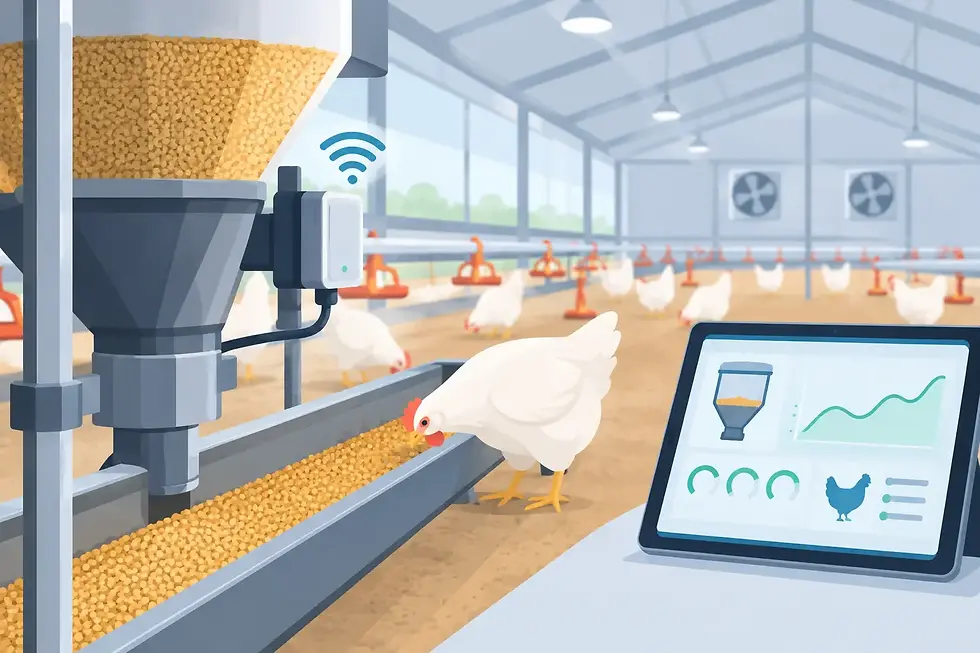
An integrated controller platform such as Agromatic Columbus AGM can bring climate inputs, fan staging, static pressure, humidity, and remote oversight into one operating view. The value is not just remote access. It is the ability to compare what the controller commands with what the house is actually delivering and correct deviations before they affect flock performance.
The best tunnel ventilation program is one that can be verified on the floor. Measure airflow, compare zones, maintain the equipment, and adjust control logic to the house and flock in front of you. Consistent conditions are built through disciplined control of the entire air path.


Comments