


Can Feed Valves Improve Uniformity in Poultry?
A breeder house can have the right feed allocation on paper and still produce uneven birds. One feed line may begin filling earlier, one circuit may run longer, or a valve may deliver a slightly different volume than intended. Over days and weeks, those small differences become visible in body weight distribution, flock uniformity, and production results. So, can feed valves improve uniformity? Yes, when they are part of a controlled feeding system that delivers the intended amount at the intended time, verifies performance, and is maintained correctly.
Feed valves do not replace sound nutrition, adequate feeder access, or flock management. They give production teams a more repeatable way to control feed distribution - a critical requirement where feed allocation and timing directly influence bird development.
How Feed Valves Improve Uniformity
A feed valve controls when feed is released to a drop tube, feed line, or feeding circuit. In a properly designed system, each valve operates according to a programmed sequence, allowing the house controller to manage delivery across zones or lines rather than relying on a single uncontrolled release point.
The direct benefit is consistency. When valve opening time, discharge sequence, and feed quantity are controlled, birds have a better opportunity to receive comparable access to feed. This is particularly valuable in breeder and pullet operations, where daily feed allocation is tightly managed and variation in intake can widen body weight spread quickly.
Uniformity improves when the feeding system reduces three common sources of variation: unequal delivery between lines, inconsistent timing between areas of the house, and differences between the feed amount recorded and the feed amount actually delivered. A valve is only one component, but it is a component with a direct effect on how feed moves from storage to birds.
Control Timing, Not Just Total Feed
Many feeding programs focus first on total pounds delivered to the house. That number matters, but it does not describe how evenly feed was distributed. If one side of the house receives feed well before the other, bird behavior changes. More aggressive birds can gain an advantage, while later-fed groups may experience greater competition and stress.
Valve control allows managers to define feeding events with more precision. A controller can coordinate the order in which circuits run, set opening durations, and apply programmed delays where the feeding system requires them. The goal is not simply to make every valve run at once. The goal is to deliver feed in a sequence that matches the house layout, equipment design, and flock-management plan.
In long houses, the difference between a well-coordinated sequence and an uncontrolled sequence can be substantial. Feed must reach the full line quickly enough to support equal access, while avoiding overfilling, bridging, or inconsistent distribution at the far end of the system.
Valve response must be repeatable
A feed valve that opens inconsistently is difficult to manage, even with a capable controller. Wear, contamination, air supply issues, electrical faults, and mechanical binding can change response time or restrict product flow. If a valve is programmed for a ten-second release but performs differently from one cycle to the next, the programmed setting no longer represents actual feed delivery.
For this reason, valve performance should be checked as part of routine feeding-system maintenance. Teams should verify that valves open fully, close cleanly, and respond consistently to controller commands. A functional test before problems affect flock performance is far less costly than correcting a growing uniformity issue later in the cycle.
Accurate Weighing Makes Valve Control Useful
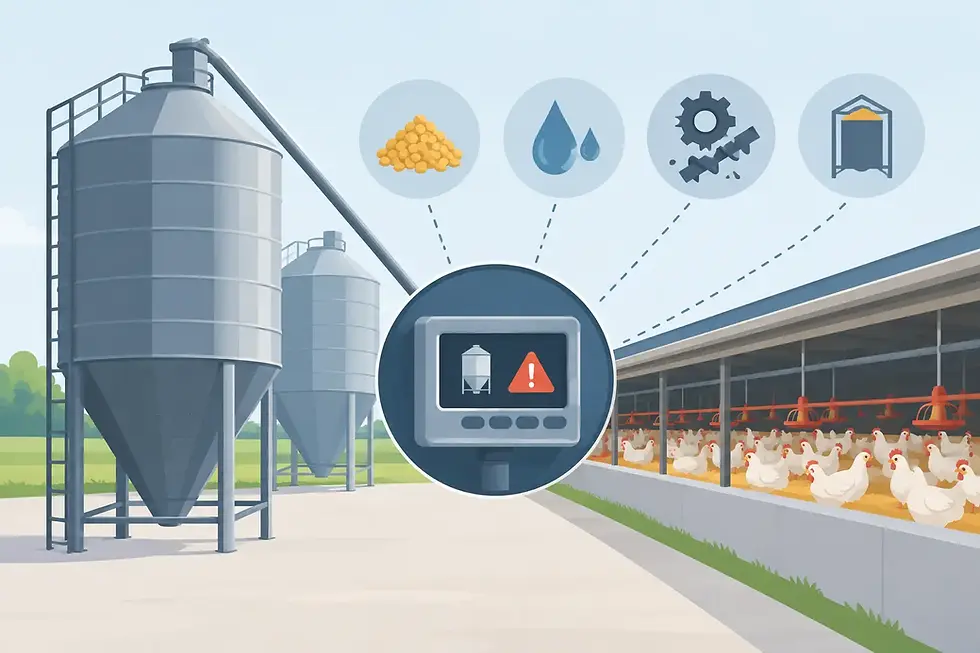
Feed valves improve delivery control, but they cannot confirm feed quantity on their own. For measurable performance, valve operation should be connected to silo weighing, batch weighing, or feed-use monitoring.
A silo weigher shows how much feed leaves storage. A batch weigher can verify a defined quantity before it is released to the house. Together with controlled valves, these measurements give managers a clearer picture: how much feed was requested, how much feed was dispensed, and whether the feeding event matched the programmed allocation.
This distinction matters when investigating poor uniformity. A house may show a correct daily feed total while still having distribution errors between circuits. Conversely, a valve issue may appear to be a distribution problem when the actual cause is an inaccurate batch scale or unaccounted feed loss. Connected measurement narrows the diagnosis.
For operations using an integrated controller platform such as the Agromatic Columbus AGM, feed functions, weighing inputs, alarms, and remote oversight can be managed within the same operating system. That reduces the gap between a feed event occurring and a production manager seeing the data needed to evaluate it.
Where Feed Valves Have the Greatest Effect
The answer depends on the production system. Feed valves typically have the greatest impact where feed allocation is restricted, bird competition is high, and small differences in delivery can affect development. Breeder, pullet, and replacement-flock programs are common examples.
Broiler operations may also benefit when valves are used to improve control of feed transfer, reduce missed feeding events, or identify line-level performance problems. However, broiler uniformity is influenced heavily by stocking density, feeder space, feed presentation, drinker management, temperature, ventilation, and health status. A more precise valve will not correct inadequate feeder access or poor environmental conditions.
Pig operations face a similar reality. Controlled feed delivery can improve repeatability between pens or feeding zones, but valve settings must match the feed type, system pressure, and feeding strategy. Equipment should be configured for the specific application rather than treated as a universal fix.
Calibration Is the Difference Between Control and Assumption
Programming a valve for a specific opening time is not the same as calibrating feed delivery. The actual amount released during that interval can change with feed density, pellet size, fines level, auger performance, bin level, moisture, and system geometry.
A practical calibration process begins by running the system under normal operating conditions and measuring the feed delivered during a defined valve cycle. Repeat the test across representative lines or zones. If the results differ, identify whether the cause is valve timing, mechanical condition, feed flow, or the line configuration.
After adjustments, repeat the test and document the settings. The objective is not to chase perfect laboratory-level equality. It is to establish a repeatable baseline and identify meaningful deviations before they affect the flock.
Calibration should also be repeated when feed form changes. A ration with different bulk density or pellet characteristics may move through the same system differently. Using last month's valve timing for a new feed formulation can introduce variation without an obvious equipment failure.
Use Flock Data to Verify the Result
The strongest way to assess feed-valve performance is to compare equipment data with bird data. Regular body weight samples, coefficient of variation, feed-use records, and observations of feeder fill all contribute to the picture.
If a particular zone repeatedly shows lighter birds or a wider weight spread, review its feed delivery history before assuming the issue is biological. Check whether the valve was activated as scheduled, whether the feed line filled correctly, and whether the measured quantity aligns with the target. Also review environmental data. Temperature differences, poor air movement, water availability, and lighting variation can create patterns that look like a feed-distribution problem.
Remote access adds value here because it allows managers to review alarms, feeding activity, and sensor information across facilities without waiting for the next site visit. Fast visibility supports faster correction, especially when a repeated valve fault or feed-flow issue develops outside normal working hours.
Common Limits to Expect
Feed valves can improve uniformity, but only within the limits of the overall feeding system. Four conditions can reduce their impact:
Insufficient feeder space can prevent lower-ranking birds from eating, even when every line receives the correct feed amount.
Poorly leveled or maintained feed lines can create unequal pan fill and uneven bird access.
Inaccurate scales or uncalibrated sensors can make feed records appear correct when actual delivery is not.
Environmental variation between zones can change feed intake independently of valve performance.
The practical approach is to treat the valve as a controllable point in a larger system. Feeding hardware, measurement devices, controller logic, and barn conditions must work together.
Specify the System Around the House
Before selecting or upgrading feed valves, evaluate the number of feed circuits, house length, feed type, delivery method, required control resolution, and available weighing inputs. A simple on-off valve may be sufficient for some transfer applications. A house needing zone-level management and traceable feed events may require more detailed controller integration and measurement.
Also consider serviceability. Farm-ready equipment must withstand dust, vibration, frequent cycling, and the realities of a working livestock house. Clear diagnostics, accessible wiring, reliable switching, and expandable control capacity are operational advantages, not optional extras.
Better uniformity is rarely the result of one setting or one component. It comes from making feed delivery consistent, measuring what actually happens, and acting quickly when the data shows a deviation. Feed valves provide a practical control point in that process - and when they are matched with accurate weighing and disciplined management, they can help turn a feeding plan into more consistent flock performance.


Comments