

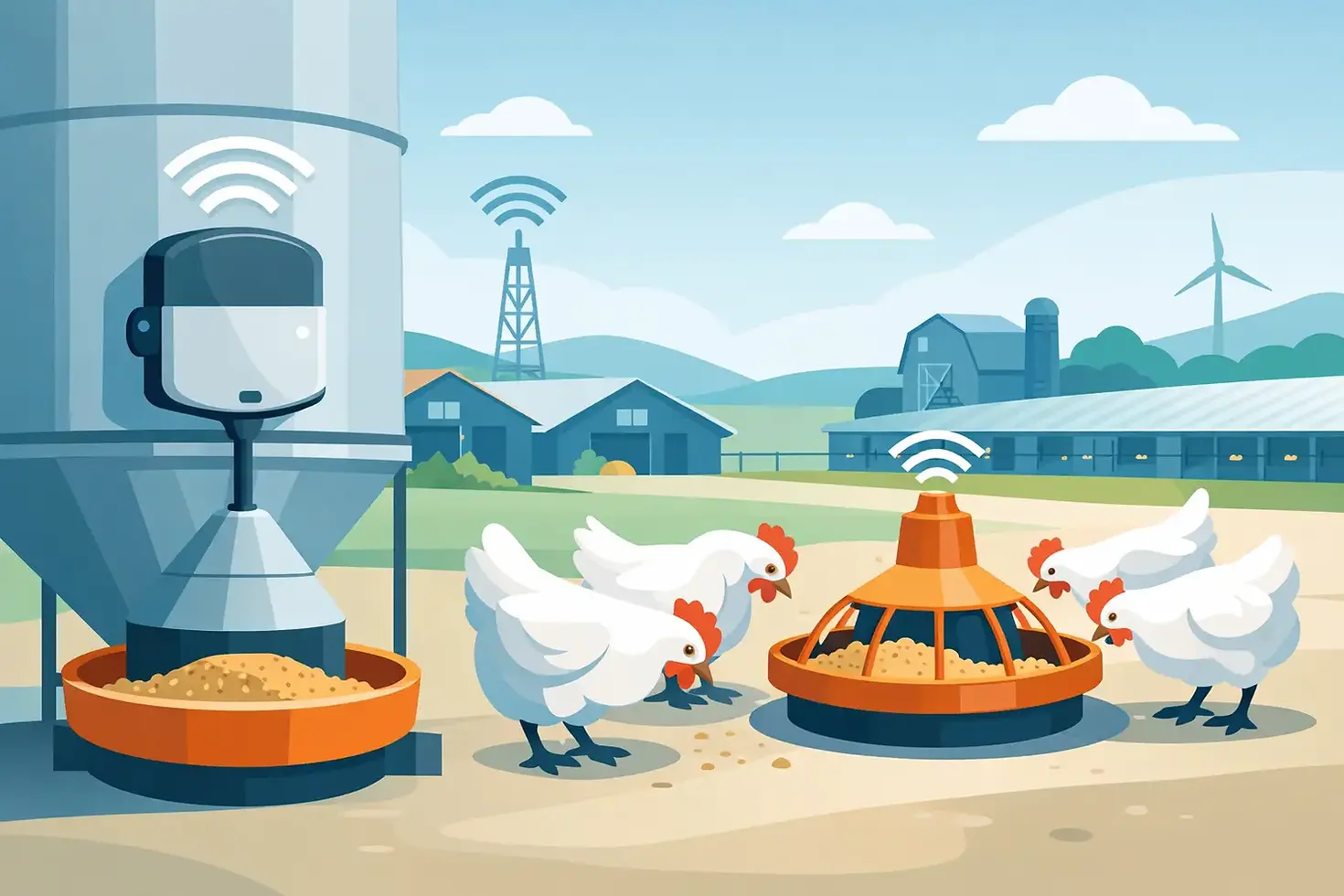
Wireless Feed Sensor for Poultry Farm Use
Feed outages do not wait for a convenient time. In a commercial house, a missed refill signal can turn into disrupted intake, uneven bird performance, and unnecessary labor within hours. That is why a wireless feed sensor for poultry farm operation is not a minor accessory. It is a control point that helps keep feed delivery visible, timely, and manageable across the full production cycle.
What a wireless feed sensor for poultry farm control actually does
At the house level, the job is simple. The sensor detects feed presence or feed level at a defined point in the line or hopper and sends that status wirelessly to the control system. Instead of relying on manual checking or hardwired retrofits, the farm receives a live signal that shows whether feed is present, low, or absent where it matters.
That simplicity matters because feed control is rarely isolated. It affects bird access, feed conversion, flock uniformity, and labor planning. In a modern poultry operation, the value of the sensor is not just that it detects feed. The value is that it turns one physical condition inside the house into usable operating data.
Wireless communication also changes the installation equation. In many existing houses, pulling new cable is expensive, disruptive, or impractical. A wireless sensor reduces that barrier. It gives producers a way to add monitoring points without opening walls, suspending major equipment, or redesigning the house around the wiring.
Why wireless feed monitoring matters in poultry houses
Feed is one of the largest operating costs in poultry production, so any blind spot around feed availability has direct consequences. If a line runs empty longer than expected, birds do not simply pause in a neutral state. Intake patterns shift. Dominance behavior can intensify. Uniformity can drift. In breeder and layer systems, the timing issue can be even more sensitive.
A wireless feed sensor helps reduce those blind spots. It gives the manager a more immediate view of feed conditions in the house and supports faster corrective action. That could mean identifying a delivery interruption, a feed line problem, a blocked component, or a mismatch between system demand and refill timing.
There is also a labor angle. Many farms still depend on routine visual checks to confirm feed status at multiple points. That works, but it consumes time and depends heavily on consistency from shift to shift. Wireless sensing does not eliminate the need for good stockmanship, but it reduces repetitive checking and moves the team toward exception-based management. Staff can respond to alerts and trends instead of walking the same confirmation route over and over.
Where a wireless feed sensor fits in an integrated control system
The strongest results usually come when feed sensing is part of a broader automation platform rather than a standalone signal. Feed status becomes more valuable when it can be viewed alongside bird weights, ventilation settings, humidity, temperature, and alarm history.
For example, if intake behavior changes and bird weight gain softens, feed availability data can help narrow the cause faster. If a house shows recurring low-feed events at a certain time of day, managers can compare that pattern with delivery schedules or equipment runtime. If several houses on one farm show different feed response patterns under similar environmental conditions, the issue may not be feed supply alone.
This is where system architecture matters. A wireless sensor should not create a separate island of information. It should feed into the main controller environment where the operator already manages house conditions. In that setup, feed monitoring supports faster decisions because the information is already in the operating workflow.
Agromatic approaches this as part of connected livestock control, where sensing, weighing, alarms, and house management work within one platform rather than as disconnected hardware.
Key advantages over manual checks and wired alternatives
The first advantage is installation flexibility. A wired sensor can be effective, but wiring distance, building layout, and retrofit cost often slow the project down. Wireless devices reduce physical installation work and make expansion easier when farms want to add more monitoring points later.
The second advantage is scalability. A poultry operation may start with one house or one feed line section and then expand monitoring as management goals become more specific. Wireless architecture supports that step-by-step approach better than fixed wiring in many cases.
The third advantage is operational visibility. Manual checks give snapshots. A connected sensor gives ongoing status. That difference matters when feed interruptions happen between rounds, during nights, or while staff are handling other priorities.
That said, wireless is not automatically the right answer in every building. Signal reliability depends on house structure, equipment layout, and network design. Metal surfaces, long distances, and electrical noise can affect performance if the system is poorly planned. The sensor itself may be straightforward, but the communication path still needs to be engineered for livestock conditions.
What technical buyers should evaluate
A wireless feed sensor for poultry farm use should be judged on more than detection alone. In practice, reliability under barn conditions is the first requirement. Dust, vibration, humidity, and washdown exposure all influence long-term performance. If a device works well on paper but struggles in actual poultry housing, the labor savings disappear quickly.
Signal stability is equally important. A wireless sensor that drops communication creates a new uncertainty instead of removing one. Buyers should look at transmission method, range expectations, interference resistance, and how the system reports communication loss.
Power strategy also matters. Battery-powered devices can simplify installation, but battery life, service intervals, and replacement access should be clear from the start. In a large operation, maintenance planning is part of the return on investment.
Integration should be evaluated carefully. Can the sensor report directly to the farm controller? Can it be used in alarm logic? Can managers see its status through remote access tools? Can the system grow without requiring a full hardware replacement? These questions matter because poultry operations rarely stay static. Houses are updated, new production targets are introduced, and data expectations increase over time.
Best-fit applications across poultry production
Broiler farms often benefit from wireless feed sensing because feed continuity directly supports growth consistency and feed conversion management. In large houses, adding monitoring without running extra cable can be especially attractive during upgrades.
Breeder operations may value the timing and control side even more. When feed programs are tightly managed, accurate feedback from the house supports better execution and quicker response if something falls out of sequence.
Layer and pullet applications can also benefit, particularly where multiple zones, equipment additions, or retrofit constraints make wired expansion less practical. Turkey operations, with their own house designs and management demands, may see the same value if the sensing point and control logic are matched to the feeding system.
The common thread is simple. The more costly a feed interruption becomes, the more valuable dependable monitoring is.
Implementation realities on the farm
Getting good results is not only about selecting the sensor. Placement matters. A sensor must monitor the point in the system that best represents actual feed availability, not just the easiest place to mount hardware. Otherwise, the farm may receive a technically correct signal that does not help operationally.
Alarm settings matter too. If thresholds are too sensitive, staff will start ignoring nuisance alerts. If they are too loose, the benefit of real-time monitoring is reduced. The right setup depends on house type, feed system design, bird age, and management priorities.
Training should stay practical. Operators do not need a long theory session. They need to know what the sensor reports, what an alert means, how to verify the condition, and how to respond. The best systems reduce complexity at the user level even when the engineering behind them is advanced.
The business case is control, not just convenience
It is easy to frame a wireless feed sensor as a labor-saving add-on, but that is only part of the value. The larger gain is control. Better feed visibility supports better scheduling, quicker intervention, clearer diagnostics, and stronger consistency from house to house.
For commercial poultry producers, that kind of control has real production value. It helps protect feed access, supports management discipline, and reduces the risk that a simple feed issue goes unnoticed long enough to affect flock results. In a sector where margins are shaped by performance details, that is a practical upgrade.
The most useful technology on a poultry farm is rarely the flashiest. It is the equipment that keeps critical processes visible and dependable every day. A well-integrated wireless feed sensor does exactly that, and when feed status is easier to see, the rest of the operation gets easier to manage.


Comments