

7 Smart Poultry Farming Trends to Watch
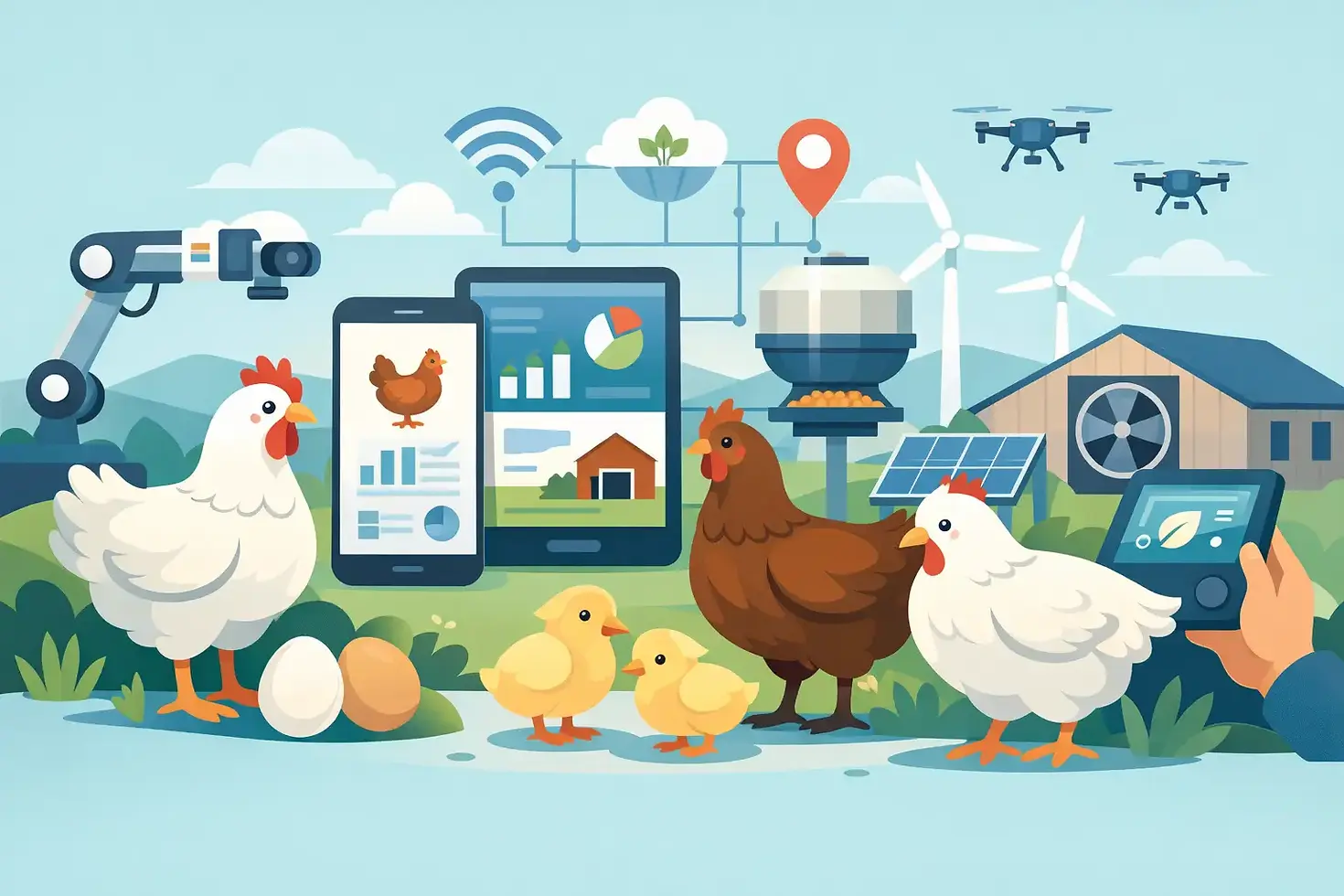
A broiler house can look stable from the aisle while performance is already drifting. A few points of extra humidity, uneven static pressure, delayed feed delivery, or missed weight variation can show up later as poorer feed conversion, flock unevenness, and avoidable stress. That is why smart poultry farming trends are moving beyond basic automation and toward tighter control, better visibility, and faster response across the entire house.
For commercial poultry producers, the change is practical. Smart systems are no longer limited to turning fans and heaters on and off. They are becoming connected control platforms that combine climate data, feed activity, bird weight, and remote access in one operating environment. The result is not just more data. It is better decisions at the right time, with less dependence on manual checks and less room for small problems to become expensive ones.
Why smart poultry farming trends are accelerating
The pressure on poultry operations is coming from multiple directions at once. Energy costs remain volatile. Labor is harder to find and retain. Flock performance targets are tighter, and production managers are expected to hit them across more houses with fewer people on site. At the same time, birds are sensitive to small environmental changes, especially in high-density production.
That combination is pushing investment toward systems that can measure more, react faster, and present clear operating data. The farms seeing the most value are not always the farms with the most hardware. They are the ones that connect measurement to action. A sensor without controller logic is only part of the answer. A controller without reliable field data is also limited. The trend is integration.
1. Integrated climate control is replacing isolated equipment logic
In older setups, ventilation, heating, cooling, and inlets may operate with limited coordination. That can keep a house running, but it often leaves efficiency on the table. Modern systems are trending toward integrated climate control where temperature, humidity, CO2, and static pressure are managed as related variables instead of separate issues.
This matters because poultry house climate is not a one-number target. For example, lowering temperature without managing humidity and air movement can still leave litter quality poor. Increasing ventilation without maintaining static pressure can create uneven air distribution. The smart approach is to use a controller architecture that balances these factors continuously.
For managers, the advantage is consistency. A well-configured control platform can maintain tighter conditions across weather changes and bird age stages, reducing the need for constant manual correction. It also makes troubleshooting faster because the relationship between measurements is visible in one place.
2. Sensor quality is becoming as important as controller capability
A climate strategy is only as good as the input data behind it. One of the most important smart poultry farming trends is the move toward more precise and purpose-built sensing across the house. Humidity sensors, CO2 sensors, and static pressure sensors are increasingly treated as critical production tools rather than optional accessories.
This shift reflects a practical reality. Producers do not manage what they do not measure well. Poor sensor accuracy or weak placement can lead to incorrect ventilation decisions, higher fuel usage, wet litter, and bird stress. Better sensors improve confidence in controller actions and reduce the guesswork that often shows up during difficult seasonal transitions.
There is a trade-off, of course. More sensing points can improve visibility, but they also require good installation, calibration discipline, and a control strategy that uses the data intelligently. Adding sensors without a clear operating plan creates noise instead of value.
3. Bird weighing is moving from periodic checks to continuous insight
Manual bird weighing still has a place, but it is no longer enough on many commercial farms. Automated bird weighing systems are gaining ground because they provide a more continuous view of flock development and uniformity. That changes how managers respond during the grow-out period.
Instead of waiting for scheduled checks, operators can track trends in real time and compare actual growth against targets sooner. If birds are lagging, too variable, or responding differently than expected after a feed or climate adjustment, that signal appears earlier. Earlier visibility means more time to correct.
The operational value is not only in average weight. Uniformity matters just as much. A house can look acceptable on average while hiding a widening spread in bird development. Smart weighing systems help expose that issue before processing or transfer stages make it costly.
4. Feed monitoring is becoming a control function, not just a record
Feed is one of the largest cost drivers in poultry production, so it is not surprising that feed monitoring is becoming more sophisticated. The trend is toward systems that track silo levels, batch delivery, feed movement, and line activity with more precision and less manual intervention.
That matters for two reasons. First, inaccurate feed visibility creates avoidable risk. Running short, over-ordering, or missing feed flow issues can disrupt bird performance quickly. Second, feed data becomes more valuable when it is connected to weight gain and environmental conditions. If feed intake changes while house climate also shifts, managers can investigate a cause rather than reacting to isolated symptoms.
Wireless feed sensors and feed control components are part of this trend because they reduce the delay between an event in the house and a response from the operator. The strongest systems do not just count feed. They help identify whether feed delivery, feed availability, or bird behavior is changing.
5. Remote access is now a baseline expectation
Commercial poultry operations are increasingly managed across multiple houses, sites, and teams. As a result, remote access is no longer a premium feature. It is becoming standard operating infrastructure. Production managers want to view alarms, settings, trends, and performance data without being physically present in every building.
The practical gain is speed. If a ventilation issue starts overnight or a sensor value moves outside target range, remote access allows an immediate check and faster intervention. It also improves oversight for owners and technical managers who are responsible for multiple farms.
That said, remote access only adds value when the interface is clear and the underlying system is dependable. Too much complexity slows response. Too little control limits usefulness. The best platforms present house status in a way that lets users act quickly, whether they are on site or off site.
6. Expandable controller platforms are replacing fixed-spec systems
One clear shift in smart poultry farming trends is the preference for controller platforms that can expand without full hardware replacement. Poultry operations change. A farm may add more sensing, integrate weighing, adjust ventilation strategy, or move toward a more connected management model over time.
Fixed-spec systems can become a limitation when those changes arrive. Expandable platforms give producers more room to grow without restarting the entire control investment. For technical buyers and integrators, this matters because it protects system life and reduces disruption during upgrades.
This is where platform design becomes a serious purchasing factor. A modern control system should be configurable for different house types and production models, while still remaining straightforward for daily use. Agromatic builds around that requirement with integrated control architecture designed for poultry house management, where climate, feed, weighing, and remote connectivity work together instead of sitting in separate islands.
7. Data is being judged by actionability, not volume
The industry has moved past the idea that more data is automatically better. Managers do not need another screen full of numbers if it does not improve operational control. The stronger trend is actionable data - information that supports a specific adjustment, warning, or performance decision.
That is why connected ecosystems are gaining traction. When environmental control, bird weight, and feed monitoring are presented together, the data becomes easier to interpret in production terms. A rise in CO2 means more when it appears alongside ventilation behavior. A shift in weight gain means more when feed activity and climate stability are visible at the same time.
For commercial poultry farms, this changes the value proposition of automation. The point is not digitalization for its own sake. The point is sharper control with fewer blind spots.
What producers should watch next
The next phase will likely be less about adding standalone devices and more about refining how systems work together. Better alarm logic, improved remote interfaces, stronger cross-house benchmarking, and easier configuration updates will continue to matter. So will durability. In livestock environments, electronics must perform under dust, moisture, and constant use. Smart technology only pays if it remains reliable in real barn conditions.
Producers evaluating new systems should look past feature counts and ask harder questions. Does the system reduce response time? Does it improve consistency across houses? Can it scale without unnecessary replacement? Can staff use it confidently every day? Those questions usually reveal more than a long spec sheet.
The farms gaining the most from smart control are not chasing trends for appearance. They are investing where precision improves performance, labor becomes more efficient, and management gains better command of the house. That is where smart poultry systems stop being technology projects and start becoming production tools.


Comments