


How to Set Poultry Alarm Thresholds Correctly
A poultry-house alarm that activates after birds are already panting, huddling, or off feed is not protecting production. To set poultry alarm thresholds effectively, build alarms around the flock's current requirements, the house ventilation mode, and the time available for a crew to respond. The goal is not to alarm at every small change. It is to identify conditions that require attention before they become a flock-health, welfare, or performance problem.
Start With the Production Program, Not a Default Number
There is no single temperature, humidity, or air-quality limit that works for every poultry house. A threshold appropriate for a seven-day-old broiler can be unsuitable for a heavy broiler in hot weather. Breeders, pullets, turkeys, and layers also have different ventilation demands, bird densities, and responses to environmental change.
Set alarm limits from the farm's approved production program and adjust them by bird age, house type, season, and ventilation stage. The controller's active temperature setpoint is the starting point, but it should not be the only reference. A well-configured system uses operating limits, caution limits, and emergency limits that reflect how quickly conditions can change in that specific house.
For example, a brief temperature deviation during a fan-stage transition may not require an immediate callout. A sustained deviation combined with failed fan feedback, however, requires urgent action. This distinction prevents nuisance alarms while keeping the system responsive to real risk.
Set Poultry Alarm Thresholds in Layers
A single high-temperature alarm and a single low-temperature alarm leave too much unmonitored. Use layered thresholds so the alarm system can separate a minor control deviation from a developing emergency.
Use caution and critical alarms
A caution alarm should notify the responsible person that the controller is outside its expected operating range. It allows the manager to verify equipment operation, review outside conditions, and correct an issue before bird comfort is affected.
A critical alarm should activate at a wider deviation or when the condition persists beyond an acceptable delay. This alarm needs a defined response procedure and a clear escalation path. During hot weather, the high-temperature critical limit may need a shorter delay because heat stress can develop rapidly. During cold weather, a low-temperature alarm must account for young birds, minimum ventilation operation, and heater capacity.
The difference between caution and critical limits should be large enough to prevent duplicate notifications but narrow enough to preserve response time. The correct spacing depends on house insulation, ventilation capacity, stocking density, backup equipment, and local weather exposure.
Add time delays with care
Short alarm delays can create unnecessary calls when doors open, fans change stages, or a controller is making a normal adjustment. Long delays can hide a fast-moving failure. Configure delays according to the parameter being monitored.
Temperature may need a brief delay to avoid reacting to normal transitions. Static pressure loss caused by a fan or inlet failure may justify a faster response. A power-failure alarm should be immediate, with notification based on backup power status. For high-risk conditions, use a delay only when the farm has confirmed that the condition can safely persist for that period.
Monitor rate of change when available
A house can remain within an absolute temperature limit while changing too quickly for birds to adapt. A rapid rise in temperature during tunnel ventilation, for example, can indicate insufficient fan capacity, a failed cooling system, or loss of air movement before the high alarm point is reached.
Rate-of-change monitoring adds useful early warning, particularly in large houses and regions with high summer temperatures. It should supplement absolute limits, not replace them.
Prioritize the Measurements That Affect Bird Environment
Environmental control alarms should match the sensors and equipment installed in the house. Each measurement needs a clear purpose, a sensible limit, and a response procedure that crews understand.
Temperature and humidity
Temperature remains the most immediate indicator of bird comfort, but humidity changes how birds experience heat. High humidity reduces the flock's ability to lose heat and can make a temperature that appears acceptable on the controller stressful in the house.
Set humidity alarms around the acceptable range for the production stage and ventilation strategy. Do not treat humidity as an isolated number. High humidity with elevated temperature deserves a faster response than high humidity during a cool period. Persistent low humidity may also signal excessive ventilation, heater operation, or management conditions that affect litter and respiratory comfort.
Sensor location matters. A temperature sensor near an inlet, heater, sidewall, or direct air stream may report a condition that does not represent the bird zone. Verify readings at bird height and compare sensors across the house before finalizing thresholds.
Carbon dioxide and air quality
CO2 monitoring provides a direct check on whether minimum ventilation is exchanging enough air, especially during cold weather when houses are tightly managed for heat retention. A rising CO2 trend can indicate inadequate airflow, poor inlet function, incorrect fan timing, or a ventilation component that is not operating as commanded.
Set CO2 alarm thresholds according to the farm's environmental program and applicable welfare requirements. Use a caution alarm to identify a ventilation correction opportunity and a critical alarm for prolonged or significantly elevated readings. If high CO2 occurs with high humidity or a low static-pressure reading, treat the combined condition as more urgent than any individual reading alone.
Static pressure and ventilation response
Static pressure is valuable because it confirms whether the house is achieving the pressure needed for planned inlet air distribution. An out-of-range pressure reading can point to open doors, damaged curtains, inlet failures, fan problems, or an incorrect ventilation setup.
Pressure thresholds must be tied to the current ventilation mode. A value that is normal during one stage may be incorrect during another. Instead of using one fixed alarm point all year, configure limits that follow the programmed ventilation requirements. Review the alarm during both minimum ventilation and tunnel operation, when house behavior can be substantially different.
Alarm the Equipment, Not Only the Climate
Environmental readings tell the crew that conditions are wrong. Equipment-status alarms can tell them why. Both are necessary for fast troubleshooting.
Fan proving, heater status, cooling-system operation, inlet position, water supply, feed delivery, and generator status should be monitored where applicable. A failed fan alarm is more actionable when paired with proof that the fan did not start after receiving a command. Likewise, a feed alarm should distinguish between a low feed level, a failed auger, and a communication loss from a wireless feed sensor.
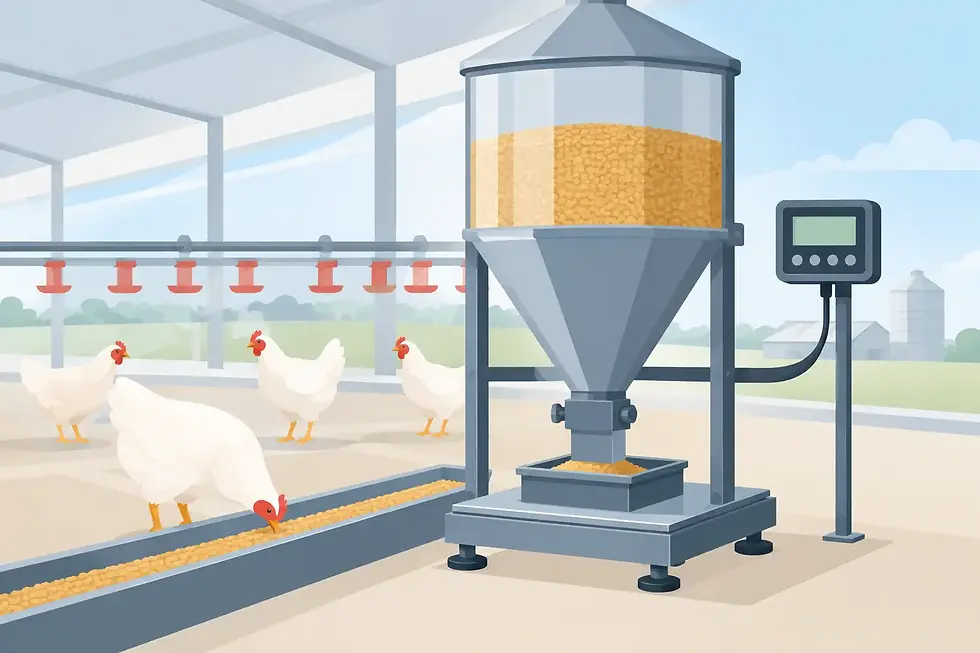
For feed bins and weighing systems, set thresholds that support purchasing and delivery decisions without creating repeated low-level notifications. A low-bin warning should leave enough feed for normal consumption, delivery uncertainty, and the farm's contingency plan. A critical low-level alarm should be reserved for a condition that requires immediate action.
Water and feed trends also deserve attention. Sudden changes in consumption can be an early signal of equipment failure, leaks, bird-health concerns, or a feed-delivery interruption. Thresholds based on expected daily patterns are often more useful than a single fixed number.
Build an Escalation Plan That Works at 2 A.M.
An alarm is only useful if someone receives it, understands it, and can act. Assign notification priority by risk. Critical climate, power, generator, and major ventilation failures should reach the primary responder immediately and escalate to a backup contact if not acknowledged. Lower-priority maintenance conditions can be logged for daytime review.
Keep alarm names specific. “House 3 high temperature” is better than “alarm active.” “House 3 tunnel fan group 2 failed to prove” is better still because it directs the responder to the likely fault. Connected controller platforms allow managers to review conditions remotely, but remote access is not a replacement for trained personnel, tested backups, and on-site emergency procedures.
Agromatic controller configurations can be expanded as monitoring requirements change, allowing environmental sensors, equipment inputs, feed controls, and remote access to operate within one farm control system. The practical advantage is not simply more data. It is a clearer connection between an alarm, its likely cause, and the equipment response required.
Test Thresholds Under Real Operating Conditions
Commissioning is not complete when the alarm screen is programmed. Test each critical alarm before flock placement and repeat the test on a routine schedule. Simulate sensor faults where safe, verify fan and generator feedback, confirm call lists, and check that the correct house identification appears in every notification.
Review alarm history after weather events, ventilation changes, and flock cycles. Repeated alarms at the same time of day may show that a threshold needs adjustment, but they may also reveal a genuine equipment or management weakness. Do not silence an alarm simply because it is inconvenient. Determine whether the limit is wrong or whether the house is repeatedly operating outside its intended condition.
The best poultry alarm thresholds are specific enough to drive action and stable enough to earn the crew's trust. When every alert has a defined meaning, a responsible person, and a tested response, the alarm system becomes part of daily flock management rather than background noise.


Comments