

Best Poultry Cooling Pad Features for Hot Houses
A poultry house can have adequate fan capacity and still lose cooling performance when the evaporative pad system is undersized, unevenly wetted, or poorly controlled. The best poultry cooling pad features are not limited to the pad itself. They must work as a complete system with tunnel fans, water supply, sump capacity, sensors, and climate controller logic.
For broilers, breeders, pullets, turkeys, and layers, cooling pad selection affects more than house temperature. It influences bird comfort, feed intake, litter condition, ventilation cost, and the production manager's ability to maintain stable conditions through peak heat. The right specification depends on house length, fan airflow, local humidity, water quality, and the cooling target - not simply the lowest installed price.
Best Poultry Cooling Pad Features Begin With Correct Design
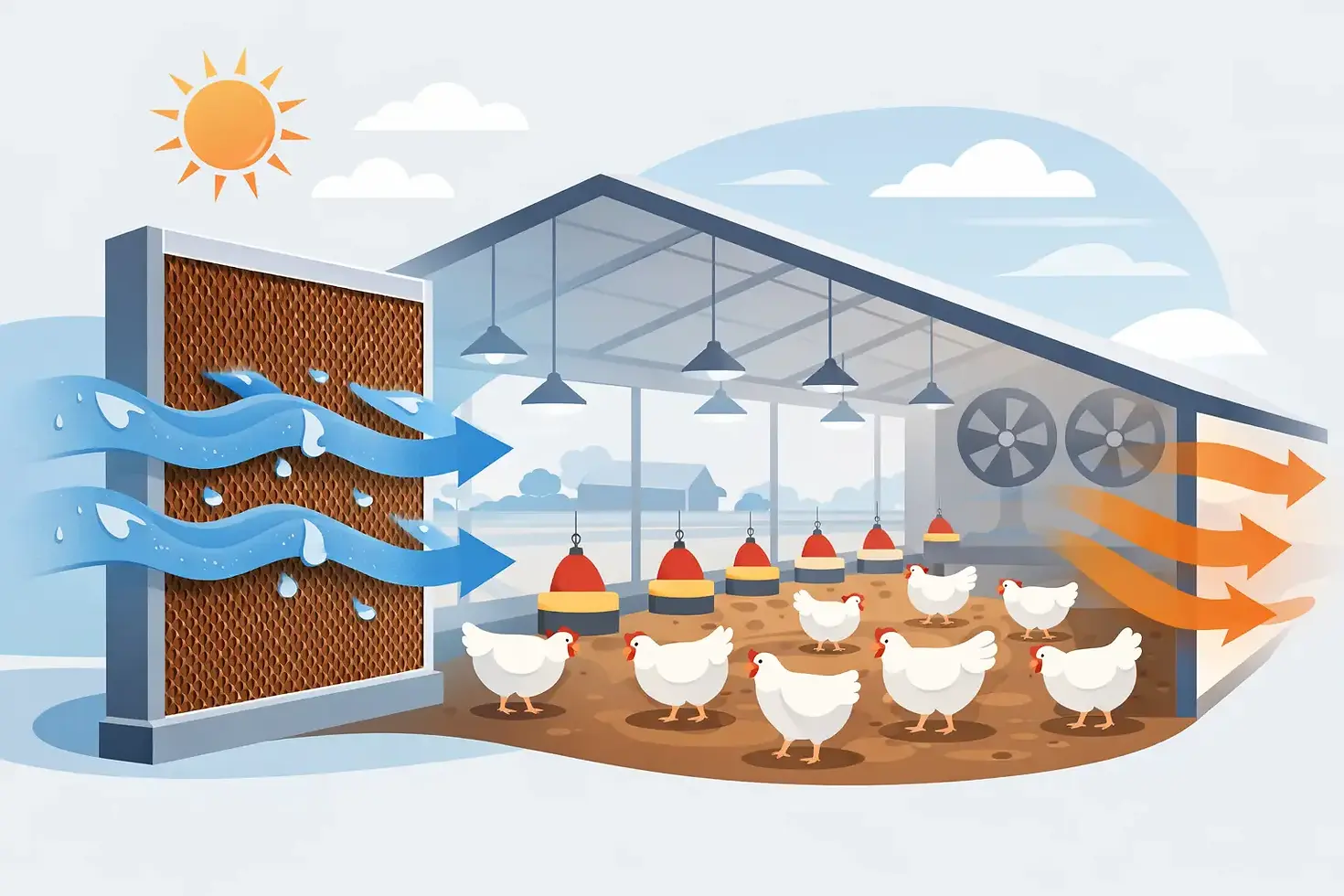
Evaporative cooling works by drawing outdoor air through a wet pad. As water evaporates, it removes heat from the incoming air before that air reaches the birds. The process is effective when the system provides enough pad surface area for the required airflow and keeps the media evenly saturated without allowing water to carry over into the house.
Pad area should be calculated against maximum tunnel ventilation volume. If the pad face is too small, air velocity through the media becomes excessive. Cooling efficiency falls, static pressure rises, and water droplets can be pulled from the pad into the inlet area. If pad area is oversized, the system may cost more than necessary and can complicate installation on some house designs.
A commercial system should be sized as an airflow component, not treated as an accessory. The climate controller, fans, inlets, and pads must be designed together. This is especially important in long tunnel houses, where poor air distribution can produce a meaningful temperature difference between the cooling end and the fan end.
Pad Depth and Flute Geometry
Pad depth is one of the first specifications to review. Thicker media generally provides more contact time between air and water, which can improve cooling performance at a given face velocity. A common trade-off is higher resistance to airflow. More depth can raise static pressure, requiring the fan system to work harder.
Flute geometry also matters. The channels within the pad direct water downward and air through the media. A well-designed flute pattern supports efficient evaporation while maintaining structural strength and appropriate airflow resistance. The best choice is not automatically the thickest or densest pad. It is the pad configuration that reaches the required cooling performance without compromising tunnel ventilation rate.
For houses in very hot, dry regions, greater evaporative capacity may justify a deeper media specification. In humid climates, the practical temperature reduction available from evaporation is lower. In those locations, adequate air speed, fan performance, and precise controller staging often have as much impact on bird comfort as additional pad depth.
High-Quality Treated Cellulose Media
Pad media must withstand continuous wetting, seasonal drying, airborne dust, mineral deposits, and cleaning activity. Treated cellulose paper remains widely used because it offers substantial wet surface area in a compact form. The quality of the paper, adhesive, edge treatment, and manufacturing consistency determines how well the media holds its shape over time.
Look for media designed to resist deterioration and maintain its channels during repeated wet-dry cycles. Weak or damaged media can collapse, create bypass gaps, and cause uneven water flow. Once air finds an open path around a damaged section, that part of the cooling wall contributes little cooling while increasing inconsistency across the house.
A durable pad should also have adequate protection at vulnerable locations, including the bottom edge and areas exposed to direct sunlight or physical contact. The frame and support arrangement are equally relevant. Even good media will perform poorly if it sags, separates at joints, or is installed with unsealed gaps.
Water Delivery Must Be Uniform and Controlled
A pad cannot cool consistently unless water reaches the entire surface evenly. The top distribution system should supply sufficient flow to wet the pad from end to end, including the furthest sections of a long cooling wall. Dry streaks reduce evaporation. Excessive flow wastes water, increases pump load, and can cause runoff or carryover.
Distribution headers need proper leveling, correctly sized holes or delivery outlets, and accessible filters. Water should form a continuous wetting pattern rather than concentrated streams. During operation, managers should inspect the pad face for dry areas, heavy streaking, algae growth, and sections that remain visibly darker or lighter than the rest.
The sump should provide enough usable water volume to support stable recirculation while allowing practical cleaning. A properly placed bleed-off or dump function helps manage dissolved minerals that concentrate as water evaporates. Without water management, scale can clog the media channels and distribution system, reducing both airflow and cooling efficiency.
Water quality changes the maintenance requirement. High mineral content, iron, sediment, or biological growth may require more filtration, more frequent flushing, and a defined treatment approach. A low-cost pad system can become expensive if it is not matched to the farm's water conditions.
Controls Make the Cooling System Productive
Cooling pads should operate through staged climate control, not as a manual response once birds are already heat stressed. The controller must coordinate fan stages, pad pump operation, inlet mode, temperature targets, humidity conditions, and alarm responses.
A practical cooling sequence often begins with ventilation capacity. Fans increase air speed over the birds before evaporative cooling is called for. As house temperature rises above the defined setpoint, the controller can activate the pump using timed cycles or continuous operation based on conditions. This approach prevents unnecessary pad wetting during marginal heat loads and reduces excess indoor humidity.
Humidity limits are essential. Evaporative cooling adds moisture to incoming air, and its value declines as outdoor relative humidity increases. A controller that uses accurate temperature and humidity inputs can avoid operating the pads when the expected cooling benefit is limited or when added moisture would create a house management problem.
Static pressure monitoring is also valuable in controlled ventilation systems. It helps identify restrictions caused by dirty pads, blocked inlet screens, improperly adjusted inlets, or fan performance issues. A rising static pressure trend can reveal a developing problem before airflow at bird level falls below target.
Integrated controls provide a stronger operating position than separate, disconnected devices. Platforms such as the Agromatic Columbus AGM controller can bring ventilation stages, sensor inputs, alarms, and remote visibility into one operating system. The value is not only convenience. It is the ability to see how cooling equipment responds to actual house conditions and make adjustments based on measured performance.
Service Access Is a Core Cooling Pad Feature
Cooling pad systems operate in a demanding environment, so maintenance access should be part of the initial design. Pumps, filters, strainers, headers, valves, sump drains, and pad sections must be reachable without unsafe climbing or extended downtime. If routine service is difficult, it will be delayed until cooling performance has already declined.
Before hot weather, inspect the system under full operation. Confirm that pumps deliver expected flow, headers wet evenly, drains function, and all pad sections remain structurally sound. Check fan belts or direct-drive fan performance, verify controller sensor readings, and test alarms. A pad wall may look acceptable while hidden scale or a restricted filter is reducing capacity.
At the end of the cooling season, clean the distribution system, remove debris from the sump, inspect media for damage, and protect components from unnecessary winter exposure. The correct cleaning method depends on pad material and water chemistry. Aggressive cleaning can damage treated paper, so follow the media manufacturer's requirements rather than applying a one-method approach to every pad.
Select Features for the Entire House, Not a Catalog Page
The best poultry cooling pad features are the ones that match the airflow, humidity conditions, water supply, building layout, and management strategy of the specific operation. Deep media, premium paper, high-flow pumps, and advanced controls all have value, but only when they are sized and configured as one system.
Start with measured fan capacity and a realistic heat-load plan. Then verify pad face area, media depth, water distribution, filtration, sensor placement, controller logic, and service access before installation. When the first extreme heat event arrives, a properly engineered cooling pad system gives the production team control instead of another urgent problem to manage.


Comments