

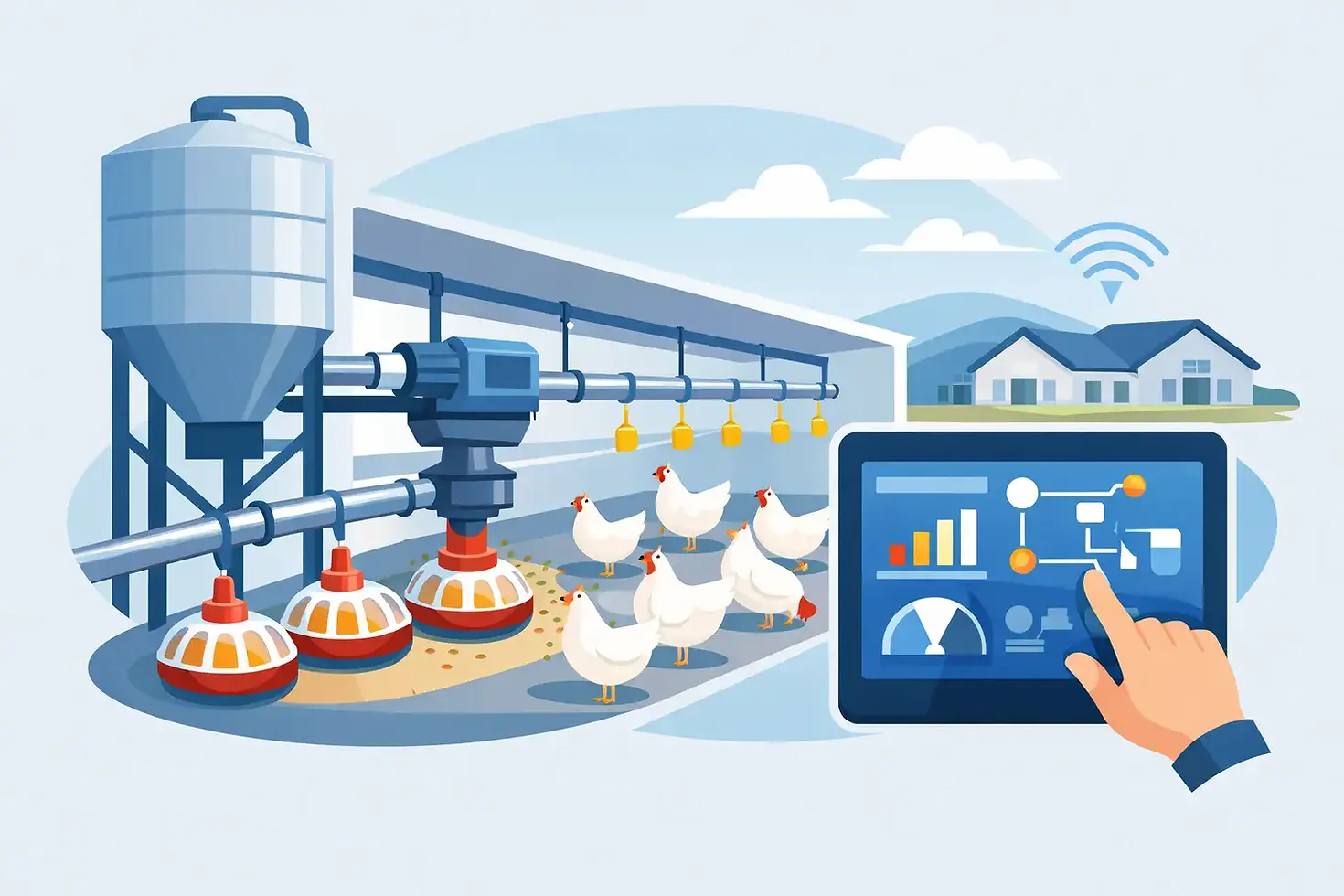
Feed Valve Control System for Poultry Houses
When a feed line keeps running after the birds have already reached target fill, the problem is rarely the auger alone. More often, the weak point is the feed valve control system - the part of the house that decides when feed demand is real, when the line should start, and when it should stop. In commercial poultry production, that decision affects feed waste, labor time, bird uniformity, and how accurately managers can read actual consumption.
A feed valve control system is not just a switch on a line. In a modern house, it is a control layer that connects feed valves, sensors, line logic, alarms, and the main controller into one operating function. If that function is unreliable, the result shows up fast - overfilled pans, empty sections of the house, unnecessary motor runtime, poor visibility into feed use, and more manual checking than the farm should need.
What a feed valve control system actually does
At the equipment level, the job is straightforward. The system monitors demand at the feed line and controls the feed supply so product moves when birds need it and stops when the line is satisfied. In practice, that means managing the response between feed valves, feed sensors, motor operation, and controller logic.
In poultry houses, timing matters. If the response is too slow, birds can face uneven access along the line. If the response is too aggressive, feed can cycle too often, increasing wear on equipment and reducing stability. A properly configured system balances responsiveness with controlled operation.
That balance becomes more valuable as houses become more automated. Production managers are no longer looking only for line function. They need traceable feed activity, alarm handling, and compatibility with broader house controls. The feed system cannot operate like a standalone mechanical accessory if the goal is full-house performance.
Why feed valve control system design matters
A feed valve control system has direct impact on two things producers watch closely - feed efficiency and management time. Feed is one of the highest operating costs in any poultry or pig operation. If a control setup allows overfeeding, delayed response, or inconsistent line behavior, the cost shows up in waste first and flock performance second.
The management side matters just as much. Houses that require staff to repeatedly inspect feed line status, reset faults, or compensate for inconsistent valve behavior are houses that consume labor without adding value. Automated control should remove routine intervention, not create a new layer of troubleshooting.
There is also a data issue. In many older setups, farms know how much feed entered the building, but not how reliably the delivery process matched demand inside the house. A stronger control architecture gives more useful signals - when feed was requested, how often the system ran, whether sensors reported correctly, and when alarms occurred. That supports better decisions than simple motor-on time alone.
Key components in a feed valve control system
The basic components are familiar, but system performance depends on how well they work together. Feed valves create the local demand signal. Sensors confirm feed presence or absence at critical points. Motors and relays drive delivery. The controller applies the logic, timing, and alarm structure that turns separate hardware into a coordinated process.
The controller is where the difference between basic operation and usable automation becomes clear. A simple on-off setup can move feed, but it offers limited flexibility. A configurable controller can manage delay times, response thresholds, alarm windows, and integration with weighing, silo monitoring, or house management functions.
That matters in real production because not every house behaves the same. Broiler houses, breeder operations, pullet houses, and pig barns each place different demands on feed delivery. Line length, feed type, stocking density, and feeding strategy all affect how the control logic should be set. A fixed system may work well in one building and underperform in the next.
Feed valve control system integration with house automation
The strongest results come when the feed valve control system is part of the wider barn control platform rather than a separate device with limited communication. In an integrated setup, the same control environment can manage climate, bird weight, feed activity, and alarms from one interface.
For operators running multiple houses, this integration changes daily management. Instead of checking disconnected devices, they can view feed-related events in the same place they monitor temperature, static pressure, humidity, or body weight trends. That makes it easier to identify cause and effect. If feed activity changes sharply, managers can compare it with environmental shifts or flock behavior instead of treating each issue as isolated.
Integration also improves remote oversight. A feed problem that goes unnoticed for several hours can affect bird access and growth quickly. If the controller supports remote access and clear alarm reporting, the response time improves. That does not eliminate the need for farm staff, but it gives managers and service teams better visibility before a minor fault becomes a production problem.
Where problems usually start
Feed control faults are often blamed on the wrong component. A farm may replace a valve or a sensor when the real issue is poor system logic, incorrect timing, weak signal handling, or lack of coordination between devices. The symptom at the line does not always identify the root cause.
One common problem is nuisance cycling. If the system reacts too quickly to short demand changes, motors start and stop excessively. That increases component wear and creates unstable feed flow. Another issue is delayed refill, where line demand exists but the controller waits too long to respond. Birds at the far end of the house can feel that delay first.
Sensor placement also matters. A high-quality sensor installed in the wrong location can still produce poor control decisions. The same is true for alarm design. If alarm windows are too sensitive, staff start ignoring them. If they are too broad, the system reports too late to be useful.
How to evaluate a feed valve control system
For technical buyers, the right question is not only whether the system runs the line. The better question is whether it supports repeatable control under actual house conditions. That means looking at reliability, configuration range, ease of service, and integration with other control functions.
Controller flexibility is a major factor. Can the system be adapted to different house layouts without replacing hardware? Can settings be adjusted for line behavior, feed type, and production stage? Can updates be applied efficiently? In a commercial operation, equipment that can scale or adapt usually holds value longer than a closed system with limited field configuration.
Usability matters too. A touchscreen or clear menu structure is not about appearance. It reduces setup errors and makes troubleshooting faster for farm staff and service personnel. In busy production environments, the best control system is often the one that can be understood quickly under pressure.
Durability should be treated the same way. Feed rooms and livestock houses are not clean electrical labs. Dust, vibration, moisture, and washdown exposure all affect long-term performance. A feed valve control system has to be built for those conditions, not just for bench testing.
What modern buyers should expect
A current feed valve control system should deliver more than feed line activation. Buyers should expect dependable sensor communication, configurable control logic, alarm visibility, and compatibility with broader farm automation. If the system cannot share information with the main controller, it limits how much value the farm can get from its data.
This is where platform-based control has a practical advantage. When feed management is handled within a broader livestock control architecture, the farm gains one operating environment instead of multiple disconnected tools. Agromatic focuses on that model because feed control works better when it is tied directly to house management, not treated as a separate add-on.
There are trade-offs, of course. A more advanced integrated system requires better planning during setup, and it may be more than a small operation needs. But for commercial poultry and pig producers managing performance targets, labor efficiency, and multiple control points in the same building, the added capability is usually justified.
Choosing for the long term
The lowest-cost option at installation is not always the lowest-cost system over time. If a feed valve control system causes repeated service calls, inconsistent feed access, or weak reporting, the savings disappear quickly. Technical buyers should look at lifecycle value - stability, expandability, supportability, and how well the system fits the farm's broader automation plan.
That is especially true for operations expecting future upgrades. If bird weighing, climate control, silo monitoring, and feed control are likely to be connected later, it makes sense to choose a system that can grow without forcing hardware replacement. Expansion capability is not a premium feature. In many livestock facilities, it is basic planning.
The practical goal is simple: feed should move when needed, stop when satisfied, and report clearly to the people managing the house. When the control system does that consistently, the result is not just smoother equipment operation. It is better visibility, less wasted labor, and a feed process that supports production instead of demanding constant attention.
For modern poultry and pig facilities, that level of control is no longer optional. It is part of running a house that performs the way it should.


Comments