

Why Poultry Fans Cycle and When It Signals Trouble
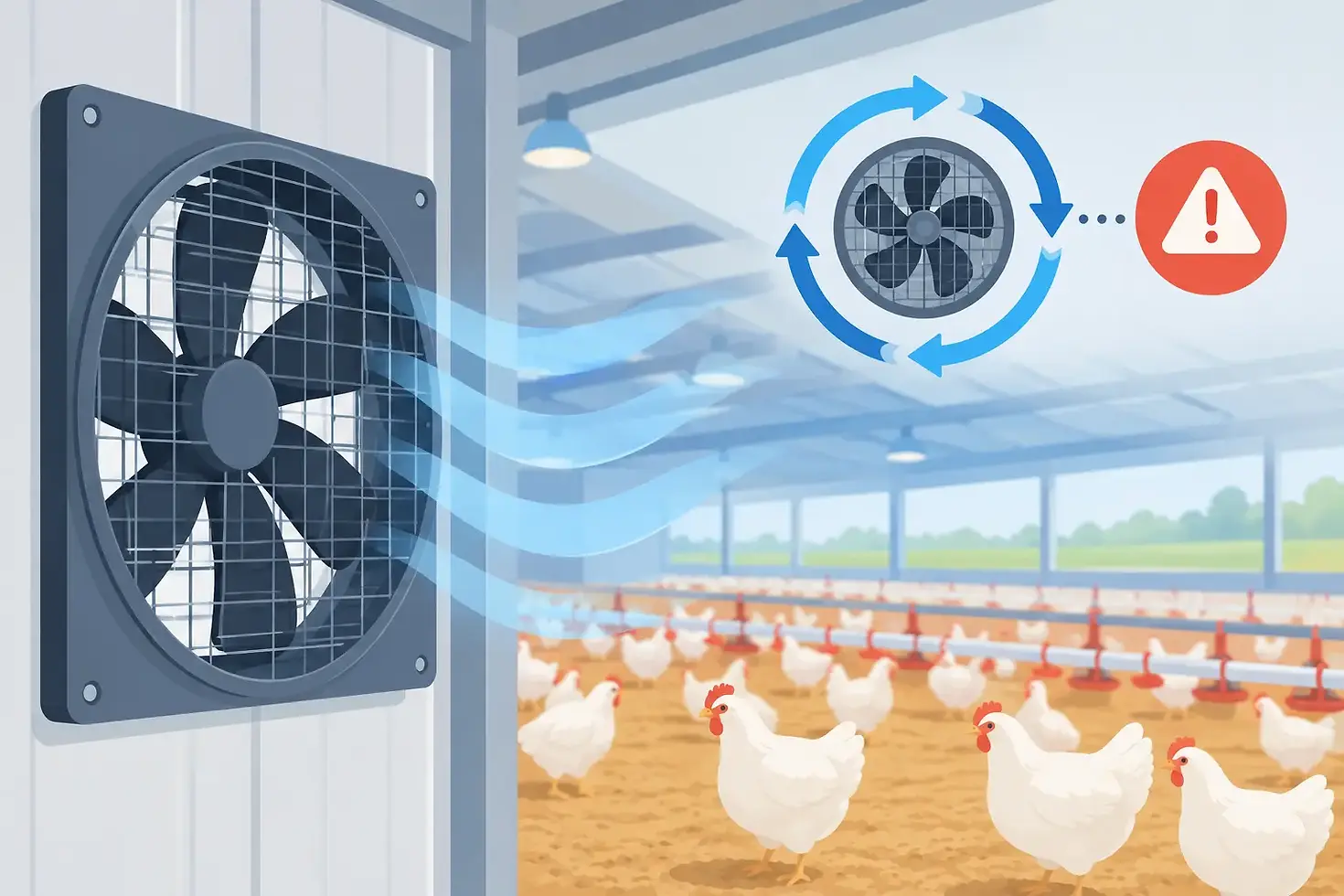
A fan that starts, stops, and starts again is not automatically a ventilation problem. Understanding why poultry fans cycle begins with the control objective: poultry houses need a measured exchange of air, not simply continuous fan operation. The correct cycle pattern depends on bird age, stocking density, outdoor conditions, house tightness, ventilation stage, and the sensor inputs driving the controller.
For commercial poultry production, cycling is often a deliberate part of minimum ventilation. It can also be an early warning that temperature differentials are too tight, sensors are poorly located, inlets are not responding correctly, or fan capacity does not match the house demand. The difference matters because improper cycling affects litter moisture, ammonia, carbon dioxide, flock uniformity, feed conversion, and bird comfort.
Why Poultry Fans Cycle During Normal Operation
During minimum ventilation, fans commonly run on a timer. The controller operates one or more fans for a defined portion of each cycle to remove moisture, carbon dioxide, ammonia, and excess heat while preserving enough house temperature for the flock. A house may use a five-minute cycle, for example, with a minimum ventilation fan operating for part of that period and resting for the remainder.
This approach is particularly important with young birds and in cool weather. Running large fan capacity continuously can remove heat faster than the heating system can replace it. Short, controlled fan run times provide air exchange without creating unnecessary drafts at bird level or excessive fuel use.
As indoor temperature rises, a climate controller typically moves from timer-based minimum ventilation to temperature-driven stages. Additional fans start as the house moves above setpoint. When temperature falls below the stage-off differential, those fans stop. This is normal staged ventilation behavior, not instability.
The fan cycle should therefore be evaluated in context. A 30-second on/off pattern may be appropriate for a small minimum ventilation fan under one set of conditions, but it may be too aggressive for a large-stage fan serving a heavily stocked broiler house. The correct answer depends on measured air quality, temperature distribution, static pressure, inlet performance, and bird response.
Why Poultry Fans Cycle Too Frequently
Frequent cycling becomes a concern when it creates uneven conditions or when equipment starts and stops without a clear ventilation demand. The most common cause is a controller setting that is too narrow for the house and equipment response time.
Temperature Differentials Are Too Tight
Every temperature stage needs a practical on/off differential. If a fan starts only a fraction of a degree above setpoint and stops as soon as temperature drops slightly, the controller may repeatedly cycle the same fan. This is often called short cycling.
Short cycling adds electrical and mechanical stress to motors, contactors, belts, and shutters. More importantly, it may produce inconsistent air movement. The house can alternate between insufficient air exchange and abrupt airflow rather than maintaining a stable ventilation rate.
A wider differential can reduce unnecessary starts, but it must be selected carefully. If the differential is too wide, house temperature may swing more than the flock can tolerate. The best setting reflects fan capacity, building volume, insulation level, bird age, heating output, and the speed at which the house responds to outside weather.
Sensor Location or Accuracy Is Driving the Wrong Response
A controller can only act on the information it receives. If a temperature sensor is placed near a heater, inlet, sidewall, or direct fan discharge, it may detect a local condition rather than the average flock environment. The controller then cycles fans based on an unrepresentative temperature.
Dirty sensors, damaged wiring, calibration drift, and poorly positioned humidity or carbon dioxide sensors can cause the same result. A temperature value that moves rapidly on the display may be a real house condition, but it may also indicate sensor exposure to a localized draft or heat source.
For reliable control, sensor placement should represent the occupied zone and avoid direct influence from equipment. Multiple sensor inputs, properly averaged by the controller, can provide a more stable and meaningful control signal in long or wide houses.
Minimum Ventilation Settings Do Not Match Flock Demand
Minimum ventilation is not fixed for the full flock cycle. As bird mass increases, moisture production, carbon dioxide output, and heat load rise. A timer program that worked during brooding may not provide enough air exchange for older birds, especially during wet weather or when litter moisture is increasing.
When minimum ventilation is inadequate, temperature may climb until the next fan stage activates. That stage then cools the house quickly and shuts off. The repeated pattern can look like a fan issue, but the actual problem is an undersized minimum ventilation rate or an incorrect transition between timer and temperature stages.
Monitor the house rather than judging settings from fan noise alone. Wet litter, condensation, elevated carbon dioxide, ammonia odor, and birds gathering away from inlets are operational signs that the ventilation program needs adjustment.
Static Pressure and Inlet Operation Affect Fan Cycling
Fans do not create effective ventilation by themselves. The incoming air must enter through properly controlled inlets at sufficient static pressure to mix with warm house air before reaching the birds. If inlets open too far during minimum ventilation, incoming cold air can drop directly onto the flock. Temperature sensors may then detect rapid local changes, causing unstable fan operation.
If inlets do not open enough, static pressure can rise beyond the intended operating range, reducing practical airflow and placing additional load on fans. Dirty inlet mechanisms, failed actuators, incorrect inlet travel, blocked openings, and house leakage can all weaken the relationship between fan runtime and delivered air.
Static pressure sensing gives the controller a way to verify how the house is responding. When fan stages change, inlet position and static pressure should change predictably. If they do not, investigate the air path before changing temperature settings. Adjusting controller differentials cannot correct a mechanical inlet problem or a leaking house.
Fan Cycling in Tunnel and Hot-Weather Ventilation
In tunnel ventilation, the target is usually sustained air speed across the birds. Major fan stages should not repeatedly stop and start when the flock needs consistent cooling. Rapid cycling during hot conditions can create temperature swings and reduce the wind-chill benefit that supports bird comfort.
A fan stage may still cycle normally around a temperature target during mild conditions or at the early transition into tunnel mode. However, once tunnel ventilation is established, verify that the programmed stages match the required airflow and that cooling equipment is not forcing contradictory control actions.
Evaporative cooling adds another control layer. If cooling pads, fogging, or other systems lower temperature too quickly, fans may stage down and then restart as heat load returns. The goal is coordinated control: fan capacity, cooling output, humidity limits, and temperature stages should operate as one sequence.
High humidity changes the decision. On a humid day, adding more evaporative cooling may provide little benefit while increasing house moisture. In that case, ventilation capacity and air speed become even more critical. A controller program should account for this trade-off rather than responding to temperature alone.
A Practical Check When Fans Are Cycling
Before changing settings, determine whether the cycle is commanded by the controller or caused by an electrical or mechanical fault. Review controller history or the current output screen to see which stage is active and what input triggered it. Then compare that information with actual conditions in the house.
Use this field check:
Confirm the active ventilation mode: minimum, transitional, power, or tunnel ventilation.
Compare displayed temperature, humidity, carbon dioxide, and static pressure with independent spot measurements.
Check fan stage setpoints, timer percentages, and on/off differentials against current bird age and outdoor conditions.
Observe inlet movement, static pressure response, and air throw when each fan stage starts.
Inspect fan motors, shutters, belts, contactors, overloads, and electrical connections if cycling occurs without a controller command.
A fan that drops out because of a thermal overload or poor connection requires a different response than a fan being intentionally staged by the climate controller. Treating both conditions as a programming issue can delay corrective maintenance.
Use Integrated Control Instead of Isolated Adjustments
Poultry ventilation performs best when temperature, humidity, carbon dioxide, static pressure, and equipment status are managed as connected inputs. Changing one setting without checking the rest can shift the problem elsewhere. Increasing fan runtime may improve air quality but create drafts. Narrowing a temperature differential may hold tighter temperature control but increase equipment cycling. Opening inlets wider may reduce static pressure but sacrifice air mixing.
An integrated controller platform such as Agromatic Columbus AGM can bring these inputs and outputs into one operating view, allowing managers to evaluate stage activity, sensor readings, alarm conditions, and house response together. This supports faster troubleshooting across houses and reduces reliance on assumptions made from a single temperature reading.
The most productive question is not whether a fan is cycling. It is whether the cycle is delivering the intended air quality and bird-level conditions. When those measurements are stable, cycling is controlled ventilation at work. When they are not, the fan pattern is valuable evidence that the house needs attention.


Comments