

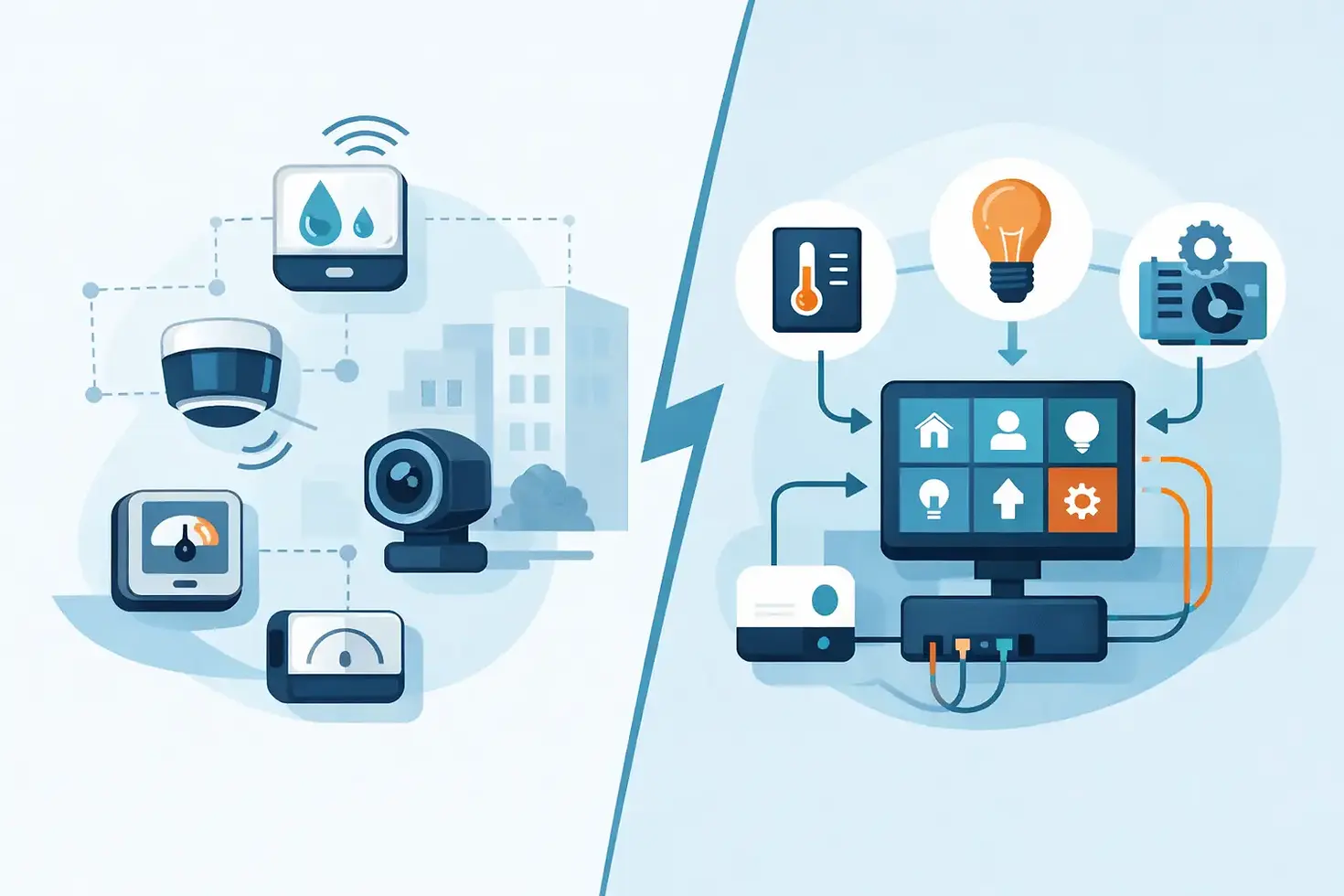
Standalone Sensors Versus Integrated Controllers
A poultry house can have accurate temperature, humidity, CO2, static pressure, feed, and weight data and still underperform. The gap is often not the sensing hardware itself. It is the control architecture behind it. That is why standalone sensors versus integrated controllers is not a minor equipment choice. It affects response time, labor, data quality, and how well the house actually runs under changing conditions.
For commercial livestock operations, this decision usually comes down to one question: do you want isolated measurements, or do you want measurements tied directly to control logic, alarms, history, and remote oversight? Both approaches have a place. The right answer depends on house size, expansion plans, labor structure, and how much operational visibility the farm needs.
What standalone sensors do well
Standalone sensors are built for focused measurement. A humidity sensor reports humidity. A CO2 sensor reports CO2. A static pressure sensor tracks pressure. In some operations, that is exactly what is needed.
This approach works well when a farm already has an established control platform and only needs to add a specific input point. It can also make sense in retrofit situations where the producer wants to solve one problem without replacing the main controller. If a house has ventilation inconsistencies and needs better static pressure feedback, adding a dedicated sensor may be the fastest route to better readings.
There is also a practical service advantage in simple systems. A failed standalone device is often easy to isolate and replace. Technical staff can troubleshoot one component without tracing interactions across a broader network. For dealers and integrators managing mixed equipment brands, standalone devices can provide flexibility where standardization is not yet possible.
That said, a sensor by itself does not improve house conditions. It only reports them. The value depends on what happens next, and in many livestock buildings, the response matters more than the reading.
Where standalone sensors start to create limits
The main limitation is separation. When sensors operate outside the main control layer, data often ends up split across different displays, different software environments, or no centralized system at all. The result is more manual interpretation and slower action.
In a poultry house, conditions shift quickly. If temperature rises, static pressure changes, and CO2 begins to build, those measurements should not sit in separate silos. They should drive fan stages, inlet behavior, alarms, and trend records together. A standalone setup can do that only if the farm has reliable integration between components. In many cases, it does not.
Another issue is scaling. One or two separate sensors may be manageable. Add environmental sensing, bird weighing, feed monitoring, silo weighing, and remote alerts across multiple houses, and complexity grows fast. Operators then spend more time checking systems, reconciling readings, and responding after the fact rather than managing proactively.
This is where the discussion around standalone sensors versus integrated controllers becomes more than a hardware comparison. It becomes a management decision.
Why integrated controllers change the operation
An integrated controller does more than collect inputs. It uses those inputs to run the building. That distinction is critical in broiler, breeder, layer, turkey, and pig facilities where performance depends on constant adjustment.
When sensors are part of the control architecture, readings are connected directly to decision-making. Temperature can influence ventilation stages. Humidity and CO2 can shape air exchange priorities. Static pressure can guide inlet performance. Bird weight data can support production tracking. Feed monitoring can flag delivery issues or consumption changes. Instead of isolated measurements, the farm gets an operating system.
That operating system also improves consistency. Different houses, crews, and production cycles can be managed against the same logic structure. Settings can be reviewed, adjusted, and documented in one place. Alarm thresholds become easier to standardize. Historical data becomes easier to trust because it is coming through one control environment rather than pieced together from separate devices.
For larger operations, that centralization is often where the real return appears. Labor savings matter, but so does decision speed. When a manager can see house conditions, feed status, and performance indicators through one interface, there is less guesswork and less delay.
Standalone sensors versus integrated controllers in daily farm use
On paper, standalone devices can look more economical. The upfront purchase may be lower if the goal is to solve one isolated issue. But daily use tends to expose the full cost structure.
A separate sensor may need its own power, display, calibration routine, communication setup, and service process. It may require staff to cross-check readings manually. If it does not feed directly into the main controller, someone still has to interpret the value and decide what to change.
Integrated controllers usually require a larger initial system decision, but they simplify operation once installed. Sensor inputs, control outputs, alarms, and recorded history are organized inside one platform. Expansion is also more predictable. Adding more functions does not always mean adding more disconnected hardware layers.
This matters in livestock production because farms rarely stay static. A house that starts with basic climate control may later need additional CO2 monitoring, feed tracking, bird weighing, or remote access. If the original design relies on separate devices for every added function, the result can be a patchwork system that is harder to manage every year.
The cost question is not just purchase price
Technical buyers often compare equipment cost first, and that is reasonable. But in livestock facilities, the better question is how the system performs across a full production cycle.
If a standalone sensor helps identify a problem but does not automate a response, labor stays in the loop. If readings are available locally but not remotely, management visibility stays limited. If data is not logged in a useful way, trend analysis remains weak. Those gaps have a real cost, even if they do not appear on the original quote.
Integrated controllers shift more value into response, coordination, and traceability. That can mean tighter environmental control, faster alarm handling, more reliable records, and better alignment between sensing and action. In high-density animal housing, that is often where operational gains are found.
Still, not every house needs a full integrated build immediately. A smaller site, an older retrofit, or a facility with a narrow monitoring requirement may still benefit from targeted standalone sensing. The key is being honest about the long-term plan. Temporary fixes have a way of becoming permanent infrastructure.
When each option makes sense
Standalone sensors make sense when the operation needs one specific measurement, when an existing control system is staying in place, or when a retrofit budget is tightly defined. They are also useful in cases where technical teams need a localized data point without changing the broader control strategy.
Integrated controllers make more sense when the farm wants centralized oversight, automated responses, cleaner data flow, and room to expand. They are especially valuable in multi-house poultry and pig operations where climate control, feed activity, animal performance, and alarms need to work together rather than as separate functions.
For many commercial farms, the decision is not strictly either-or. A strong integrated controller can serve as the core system while selected specialized sensors extend capability where needed. That kind of architecture gives the farm both control and flexibility, without forcing operators to manage a disconnected set of tools.
Agromatic’s approach is built around that principle - bring climate control, monitoring, weighing, feed functions, and remote access into one expandable platform so the house can be managed as a complete production environment, not as a collection of separate devices.
The better question to ask before you buy
Instead of asking which component is better in isolation, ask what level of control the house needs over the next five years. If the answer includes better visibility, faster response, easier expansion, and less manual intervention, integrated control usually has the stronger case.
If the goal is narrow, local, and short-term, standalone sensing can still be the right fit. But on modern livestock sites, the pressure is moving toward connected systems that turn measurements into action without adding operational friction.
The farms that get the most from their electronics are usually not the ones with the most devices. They are the ones with the clearest control strategy.


Comments