

Poultry Environmental Monitoring Guide for Better Control
A poultry house can look normal at 7:00 a.m. and still be moving toward a production problem. A fan may be running without delivering the intended air exchange. A humidity reading may be acceptable at one sensor location while litter moisture builds along a sidewall. Feed use may rise before bird weights reveal the underlying issue.
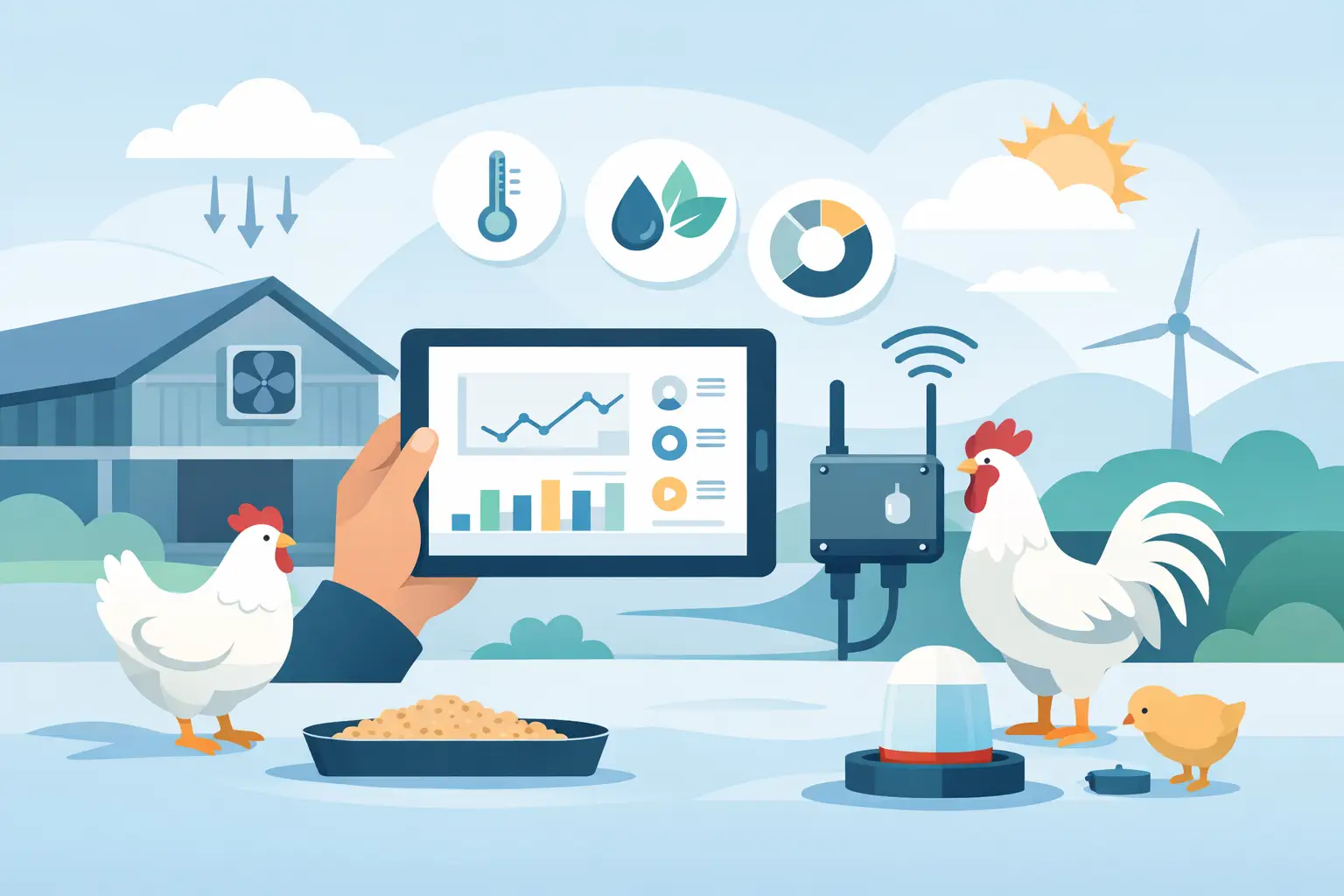
This poultry environmental monitoring guide is built around one operating principle: measure the conditions that affect flock performance, then use connected data to make timely corrections. Environmental control is not a set-and-forget task. It is a continuous process of sensing, comparing, responding, and verifying.
Start With the Conditions That Drive Flock Performance
Temperature is the most visible climate value, but it does not operate alone. Birds respond to the combined effect of temperature, relative humidity, air speed, carbon dioxide, static pressure, stocking density, litter condition, bird age, and feed and water activity. A controller can hold a temperature target while the house still experiences poor air distribution or insufficient minimum ventilation.
For commercial broiler, pullet, turkey, breeder, and layer operations, the monitoring system should show what is happening in the bird zone, not only what is happening near a controller or sensor mounted at a convenient height. Sensor placement, equipment calibration, and trend visibility determine whether the data can support a production decision.
The operating objective is not simply to collect more numbers. It is to identify a change early enough to protect bird comfort, air quality, feed conversion, uniformity, and labor efficiency.
Temperature: Monitor the Target and the Spread
House temperature should be monitored at representative locations, particularly in long houses or houses with known hot and cold areas. A single reading can conceal a meaningful temperature spread between the inlet end, center, and fan end. This matters most during brooding, seasonal transitions, and periods of high ventilation demand.
Setpoints should follow the flock program, but trend data is equally valuable. A repeated temperature drop when a specific fan stage starts may indicate poor inlet performance, excessive air speed at bird level, or a control sequence that needs adjustment. A repeated afternoon rise may point to insufficient cooling capacity, solar load, or fan performance.
Temperature alarms need practical delay settings. An alarm that activates for every short controller correction creates alarm fatigue. An alarm with too much delay can miss a real failure. The right setting depends on bird age, outside conditions, house insulation, and how quickly the house can change after a ventilation or heating fault.
Humidity and Litter: Treat Them as a Production Signal
Relative humidity gives an early indication of moisture management, but it should be read alongside water consumption, ventilation runtime, temperature, and litter observations. High humidity can result from inadequate minimum ventilation, water leaks, wet cooling conditions, or a house that is too cool to carry moisture effectively. Low humidity during brooding can increase dust and make it more difficult to maintain a stable chick environment.
There is no single humidity number that fits every farm, season, or bird type. The useful question is whether humidity is stable and appropriate for the current temperature, bird age, and ventilation mode. If humidity remains elevated while ventilation stages increase, inspect inlet function, fan capacity, and moisture sources before simply changing the target.
Monitor litter condition in routine walk-throughs. Sensors cannot replace visual inspection of wet areas under drinker lines, around cooling pads, or near sidewalls. They can, however, show whether those observations align with rising humidity, changes in water use, or reduced airflow.
Carbon Dioxide: Verify Minimum Ventilation Performance
Carbon dioxide monitoring is especially valuable during cold weather and brooding, when houses are sealed more tightly and ventilation rates are lower. Elevated CO2 can indicate that minimum ventilation is not exchanging enough air, even if temperature is holding at setpoint.
Use CO2 trends to confirm that timer-based or demand-based minimum ventilation is producing the intended result. If CO2 rises steadily overnight, check fan operation, inlet opening, static pressure, fan belts, and control settings. Also review whether heaters are operating longer than expected, since combustion contributes to CO2 levels.
A CO2 sensor should be installed and maintained according to its intended operating range and location. A sensor placed too close to a heater, inlet, or exhaust point will not represent the average air conditions experienced by the flock.
Poultry Environmental Monitoring Guide: Read Airflow, Not Just Fan Status
A fan status signal tells you that the controller has called for a fan. It does not always prove that the fan is moving the required volume of air. Belt condition, dirty shutters, fan wear, electrical faults, and obstruction can all reduce delivered performance.
Static pressure is a critical measurement for houses using controlled air inlets. It helps verify that fans and inlets are working together to direct incoming air across the ceiling before it reaches the birds. Too little pressure may allow cold air to fall directly into the bird zone. Excessive pressure can restrict airflow or indicate insufficient inlet opening.
The correct pressure range depends on house design, inlet type, ventilation stage, and outside weather. Rather than relying on one fixed number, establish expected pressure behavior for each operating mode. When the controller changes from minimum ventilation to a higher stage, compare static pressure, inlet position, fan operation, and temperature response. That comparison is more useful than viewing any single value in isolation.
A practical monitoring screen should bring together four related readings:
House temperature by zone or sensor location
Relative humidity and carbon dioxide trend
Static pressure and inlet or fan stage status
Alarm state, ventilation mode, and equipment runtime
When these values are visible together, the production manager can distinguish between a sensor issue, a control issue, and a mechanical airflow issue more quickly.
Connect Environmental Data to Feed and Bird Weight
Environmental data becomes more valuable when it is compared with production data. A climate event may appear minor in isolation but become significant when it coincides with lower feed intake, uneven weight gain, increased water use, or reduced flock uniformity.
Bird weighing systems provide a frequent view of growth trends without requiring manual samples to carry the full burden of verification. Automatic weights should be reviewed for sample quality as well as average weight. If only a small number of birds are using a scale, or if the same group repeatedly dominates the sample, the data may not represent the flock accurately.
Feed monitoring adds another layer of control. Silo and batch weighing, feed valves, and feed sensors can show when consumption changes by house, line, or feeding event. An increase in feed use may be expected during a weather shift, but it may also indicate that birds are compensating for a cold environment. A decline in consumption can be an earlier warning than a visible change in body weight.
The best analysis is time-based. Compare environmental trends and feed activity over the same hours or days. For example, if a CO2 rise occurs during overnight minimum ventilation and morning feed activity drops, the relationship deserves investigation. It does not prove causation by itself, but it gives the farm a clear place to start.
Build Alarm Rules That Support Action
An alarm system is only useful when the people receiving alarms know what to do next. Separate alarms into conditions requiring immediate response, conditions requiring inspection during the next round, and maintenance alerts that can be scheduled.
Immediate-response alarms typically include power loss, extreme high or low temperature, communication failure, critical ventilation fault, and high CO2 conditions. Inspection alarms may include a pressure value outside its normal pattern, unusual humidity movement, or a water and feed trend that has moved beyond the farm's established range. Maintenance alerts can flag sensor calibration intervals, runtime imbalances, or equipment that is cycling more often than expected.
Remote access is valuable because it puts current conditions and historical trends in the manager's hand without requiring a trip to the site. It should not replace barn checks. Use remote monitoring to prioritize attention, confirm controller response, and identify whether an alarm is isolated to one house or part of a wider site issue.
Agromatic's Columbus AGM controller platform is designed around this connected approach, combining climate control, sensor inputs, production measurements, and remote access in a configurable poultry house control system.
Maintain the Measurement System
A monitoring program is only as accurate as the devices feeding it. Sensors need regular inspection, cleaning, functional checks, and calibration where required. Dust, moisture, corrosion, damaged wiring, and poor mounting can create incorrect readings that lead to incorrect control decisions.
Create a maintenance routine that verifies temperature, humidity, CO2, and static pressure sensors against suitable reference equipment or expected operating behavior. Check that fans, inlets, heaters, cooling equipment, weigh systems, and feed components respond correctly to controller commands. Review backup power and alarm communications as part of the same routine.
Document changes to controller programs, sensor replacement, fan service, and ventilation settings. When a trend changes later, that record helps distinguish a production shift from a change made to the equipment or control logic.
The value of poultry environmental monitoring is not in having a screen full of readings. It is in building a repeatable operating discipline: verify the sensor, understand the trend, check the equipment, and make the correction before the flock pays for it.


Comments