


Pig Ventilation Guide for Modern Swine Barns
A pig ventilation guide should start with one operating fact: air movement is not just a comfort setting. In a swine barn, ventilation directly affects heat stress, respiratory health, moisture control, manure gas concentration, feed intake, and daily labor. The correct system does more than turn fans on when the room gets warm. It manages fresh-air delivery, air speed, static pressure, and fan capacity as conditions change.
For commercial producers, the objective is stable conditions at pig level with the lowest practical energy use. That requires a ventilation design that matches the building, pig weight, stocking density, climate, manure system, and season. A controller can only perform as well as the sensors, equipment, and ventilation strategy behind it.
What a Pig Ventilation System Must Control
Pig barns produce heat, moisture, carbon dioxide, dust, and gases continuously. The ventilation system must remove these loads while avoiding cold drafts in winter and insufficient air speed in summer. Those requirements can compete with each other, which is why fixed fan schedules rarely deliver consistent results.
Temperature is the most visible measurement, but it is not the only one that matters. A barn can meet its temperature setpoint and still have poor air quality or wet surfaces. Relative humidity indicates whether ventilation is removing moisture effectively. Carbon dioxide levels can reveal inadequate minimum ventilation. Static pressure shows whether inlet openings are creating the air speed needed to mix incoming air before it reaches the pigs.
The practical target is a controlled environment, not maximum fan runtime. Excess ventilation during cold weather wastes heat and can chill young pigs. Too little minimum ventilation allows humidity, ammonia, carbon dioxide, and condensation to build. During hot weather, high air speed can reduce the effective temperature felt by finishing pigs, but only if the building has enough properly managed inlet area.
Pig Ventilation Guide: Match Airflow to Pig Stage
Ventilation demand changes sharply as pigs grow. A nursery room with small pigs requires careful draft protection and stable temperatures. A finishing barn carries a much greater sensible heat and moisture load, particularly at high stocking density. Breeding and gestation areas have their own requirements based on animal age, housing layout, and worker activity.
A well-configured controller uses separate ventilation stages instead of a single fan response. Minimum ventilation maintains air quality when outside temperatures are low. Transitional stages increase airflow as room temperature rises. Tunnel ventilation or high-capacity mechanical ventilation handles summer heat load, often with evaporative cooling where local climate conditions support it.
Setpoints should be based on pig weight and production stage, not copied from another building. Barn construction, ceiling height, insulation, inlet design, fan efficiency, and local weather all affect the result. The best approach is to establish a starting curve, verify actual conditions with reliable sensing, and adjust from measured barn performance.
Minimum Ventilation Is an Air-Quality Function
Minimum ventilation is commonly misunderstood as a low-speed fan setting. Its real purpose is to exchange stale air for fresh air at a controlled rate when heating demand is present. The system must run often enough to remove moisture and gases, while each fan cycle must be long enough to distribute incoming air through the room.
Short, frequent cycles can create unstable airflow and uneven mixing. Long cycles with excessive off-time can allow air quality to deteriorate between runs. Timer-based minimum ventilation remains useful in many barns, but it should be coordinated with temperature, humidity, and gas measurements rather than treated as an isolated function.
Watch for signs that minimum ventilation needs adjustment: wet ceilings or walls, condensation on equipment, elevated odor, damp bedding or floors, and pigs crowding away from incoming air. These symptoms can also point to inlet or heater problems, so the correction should be based on diagnosis rather than simply increasing fan speed.
Summer Air Speed Must Reach the Pig Zone
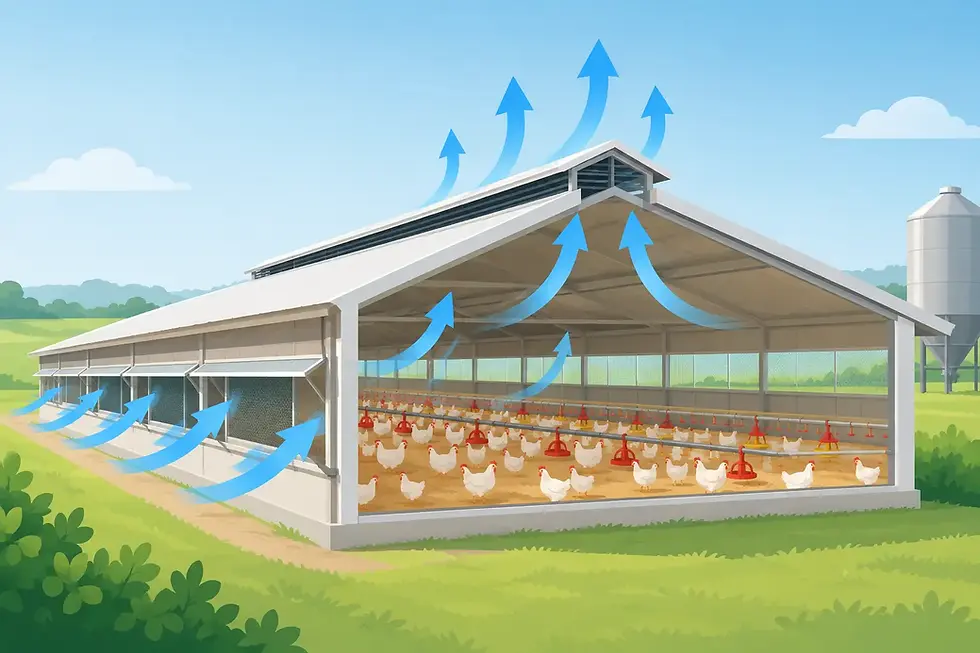
When room temperature exceeds the pigs' comfort range, air speed becomes a major cooling tool. Tunnel ventilation creates a directional air stream through the barn, increasing convective heat loss from the animals. It is highly effective in finishing buildings when the tunnel path is clear and fan capacity is correctly sized.
Air speed measured near a fan does not confirm air speed at pig level. Check multiple points along the barn, including the areas furthest from the fans. Obstructions, poor curtain sealing, inadequate inlet opening, or blocked evaporative pads can reduce performance where it is needed most.
Evaporative cooling can lower incoming air temperature, but its value depends on outdoor humidity. In humid conditions, cooling pads may add moisture without delivering the expected temperature reduction. Controls should account for both temperature and humidity, with operating logic that avoids unnecessary water use and excessive indoor moisture.
Inlets and Static Pressure Determine Air Distribution
Fans create airflow, but inlets determine where that air goes. During cold-weather ventilation, incoming air should enter with enough velocity to travel along the ceiling, mix with warm room air, and reach the pig zone without creating drafts. This depends on inlet opening, inlet location, fan operation, and static pressure.
Static pressure is a useful control measurement because it indicates resistance to airflow within the building. If pressure is too low, incoming air may fall directly onto pigs. If it is too high, fans work harder, airflow can be restricted, and distribution may become uneven. The correct operating range depends on building design, so pressure targets must be established for each house rather than assumed.
Inspect inlets as carefully as fans. Damaged actuators, uneven curtain movement, blocked openings, air leaks, and poor calibration can undermine an otherwise capable control system. In a multi-room facility, one improperly adjusted room can create a very different environment from the controller display at the central location.
Use Sensors as Operating Inputs, Not Just Alarms
A modern ventilation system should collect data that helps the controller make better decisions and helps the manager identify developing issues. Temperature sensors remain the foundation, but sensor placement is critical. Install them where they represent pig-level conditions, away from direct inlet streams, heaters, and dead-air corners.
Humidity, carbon dioxide, and static pressure sensors add meaningful operational control. Together, these measurements can identify conditions that a temperature-only strategy will miss. For example, a room at the correct temperature with rising carbon dioxide may require more minimum ventilation. A room with high humidity may need a change in ventilation timing, heat input, or water-system management.
For reliable control, maintain sensors on a planned schedule. Dust, moisture, corrosion, and physical damage affect readings over time. Compare related sensor values, investigate unexpected deviations, and replace failed devices promptly. A poor sensor can cause a controller to make the wrong decision with complete confidence.
The most useful control platforms combine these inputs with staged fan control, inlet management, heating, cooling, alarm functions, and remote access. Agromatic climate control systems are designed around this type of expandable barn-level control, allowing producers to adapt configuration as housing requirements change without replacing the core controller.
Verify the System Before Weather Tests It
Ventilation failures are often discovered during the first extreme cold night or summer heat event. Preventive checks before seasonal change reduce that risk. Confirm that each fan starts, rotates correctly, and achieves expected airflow. Clean shutters, guards, blades, and cooling pads. Test backup power, alarm notification, and emergency ventilation functions.
A complete pre-season check should include these four areas:
Fan performance, belt condition, shutter movement, and electrical connections
Inlet travel, curtain sealing, actuator calibration, and pressure response
Temperature, humidity, gas, and static-pressure sensor accuracy
Controller stages, alarm limits, backup settings, and remote communication
Do not limit validation to equipment operation. Walk the barn while ventilation stages change. Use smoke or other approved airflow visualization methods to see where inlet air travels. Observe pig behavior at different locations. Animals often show a distribution problem before sensors identify it: piling, avoiding sections of a pen, panting, or uneven resting patterns are operational signals that deserve attention.
Build a Ventilation Strategy Around Measured Results
There is no universal fan curve that fits every swine facility. A tight, insulated barn in a northern climate needs a different minimum ventilation strategy than a naturally ventilated building in a hot region. High-health facilities may set more conservative air-quality targets, while older barns may need phased upgrades to improve sealing, inlet control, or monitoring capability.
The practical advantage of connected control is visibility. Compare rooms, review alarm history, identify recurring high-humidity periods, and verify whether ventilation stages respond as intended. This turns barn climate from a daily guess into a managed production variable.
Start with accurate sensing, balanced airflow, and control settings that reflect the pigs in the building today. Then review performance regularly. Consistent air quality and temperature are built through adjustment and verification, not through a controller setting left unchanged for an entire season.

Comments