

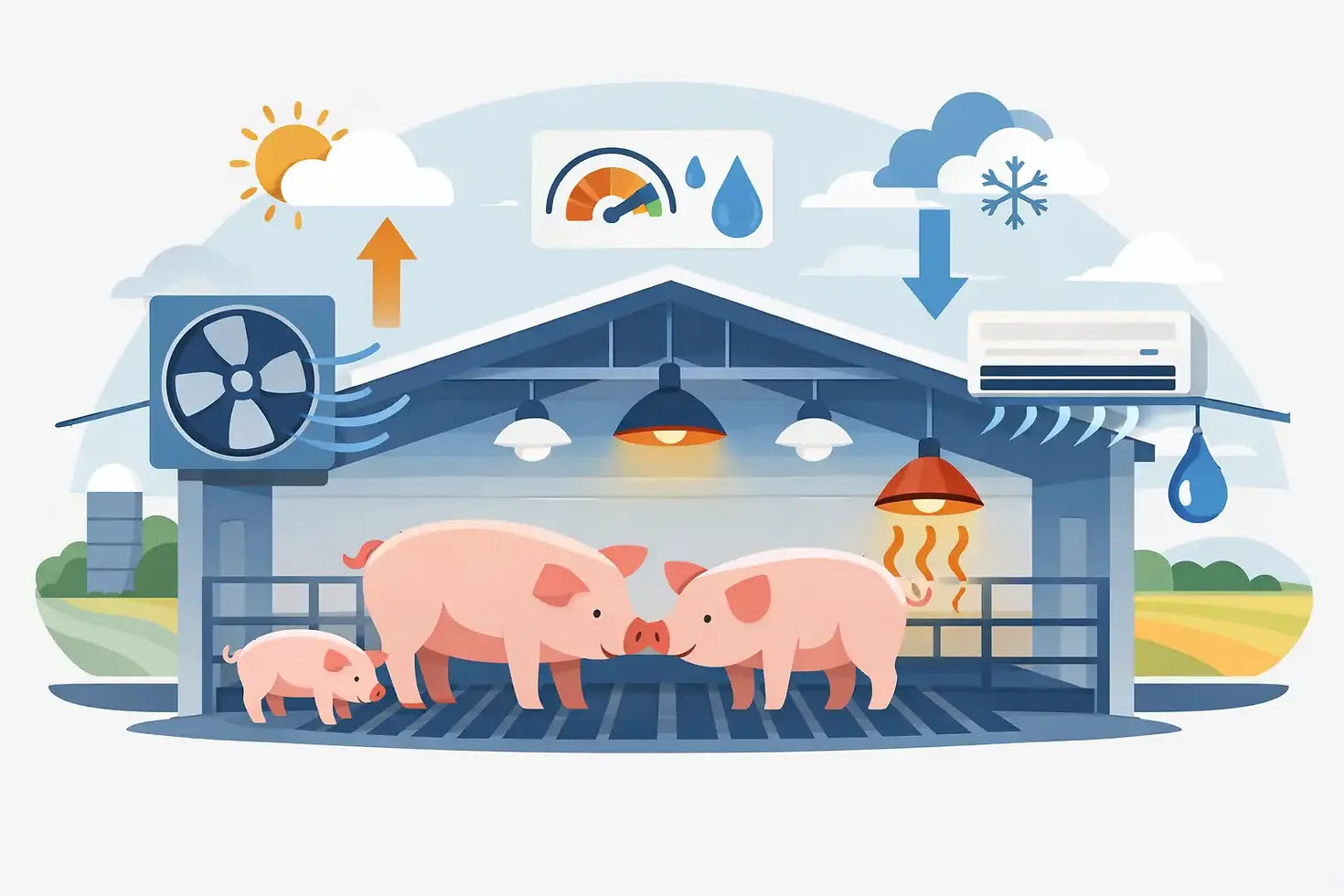
Pig Barn Climate Control System Basics
A pig barn climate control system earns its value on the days when conditions shift fast - a cold morning, a humid afternoon, a ventilation spike after feeding, or a power fluctuation that throws the room out of balance. In pig production, small environmental swings can show up quickly in feed intake, animal behavior, growth consistency, and building operating cost. The job of climate control is not simply to move air. It is to keep the barn stable, measurable, and responsive.
What a pig barn climate control system actually controls
In a modern pig barn, climate control is a coordinated process. Temperature is the starting point, but it is only one variable. Airspeed, minimum ventilation, humidity, CO2 concentration, and static pressure all affect how pigs experience the room. A barn that looks acceptable on a wall thermostat can still be under-ventilated, wet, drafty, or carrying gas levels that reduce performance.
That is why a true system combines sensors, controller logic, and output equipment into one operating structure. The controller reads environmental inputs, compares them to the setpoints for the room or zone, and adjusts fans, inlets, heaters, and in some cases cooling equipment. When the system is configured correctly, these components do not work independently. They work in sequence.
This matters because pigs at different stages do not need the same environment. Farrowing, nursery, grow-finish, and gestation barns each bring different heat load, moisture load, and ventilation demand. The control strategy for one building type should not simply be copied to another. Good climate control depends on barn-specific logic, not generic settings.
Why control accuracy matters in pig barns
Pig barns are dynamic buildings. Animal weight increases over time. Moisture production rises with stocking density and growth stage. Outside conditions can shift from dry and cold to warm and wet within hours. A basic on-off setup can keep equipment running, but it often cannot maintain the consistency needed for efficient production.
In practical terms, poor control usually shows up as over-ventilation, under-ventilation, uneven room conditions, or unnecessary heater runtime. Over-ventilation in cold weather drives up fuel cost and can chill pigs near inlets or floor level. Under-ventilation allows moisture and gases to build, creating wet surfaces, odor issues, and reduced air quality. Neither condition is acceptable when labor, feed, and energy costs are already under pressure.
A more capable pig barn climate control system improves accuracy by making smaller, timed adjustments instead of large corrections after the room has already drifted. That reduces stress on both the animals and the equipment. It also gives managers better visibility into what the barn is doing, rather than forcing them to manage by feel.
The core components of a pig barn climate control system
The controller is the decision center. It processes sensor data, applies the programmed control strategy, and sends commands to barn equipment. For commercial operations, controller flexibility matters. A system should allow different room setups, output stages, alarm logic, and sensor combinations without forcing hardware replacement every time the barn changes.
Sensors determine how useful the controller can be. Temperature sensors are standard, but humidity, CO2, and static pressure sensing add control depth that many barns need. Temperature alone cannot tell you whether incoming air is mixing correctly, whether moisture is accumulating, or whether fan and inlet performance are creating the right pressure relationship.
Ventilation equipment provides the physical response. This includes minimum ventilation fans, variable-speed fans, sidewall or ceiling inlets, tunnel components where applicable, and actuators that maintain inlet position. Heating equipment closes the loop in colder conditions. If the heater output and ventilation logic are not coordinated, the barn can end up fighting itself - adding heat and removing it at the same time.
Alarm and remote access functions are no longer optional in many operations. If a sensor fails, a fan stage does not activate, or a room temperature drifts beyond limit, response time matters. Remote visibility helps managers catch trends early and confirm barn status without depending only on physical walk-throughs.
Sensor-driven control improves decisions
A climate controller is only as effective as the information it receives. In pig housing, sensor placement and sensor type directly affect control quality. A poorly placed temperature sensor near a heater, inlet, or draft path can distort room readings and trigger unnecessary equipment response.
Humidity sensing is especially valuable in barns where condensation, wet floors, or high moisture load are common. Excess humidity can indicate inadequate minimum ventilation even when the room temperature appears normal. CO2 monitoring adds another layer by showing whether fresh air exchange is keeping pace with animal and heater demand. Static pressure sensing confirms whether the inlets and fan stages are actually creating proper air movement through the room.
This is where integrated electronics make a difference. When the controller can use several environmental inputs together, it can make better decisions than a single-parameter setup. That does not mean every barn needs every sensor. It means the control package should match the barn’s operating risk and management goals.
Ventilation strategy is where performance is won or lost
Ventilation is often treated as a fan sizing issue. In reality, it is a control issue. The best fan package in the barn cannot perform well if staging, inlet control, and pressure management are out of alignment.
Minimum ventilation is one of the most critical functions, particularly in cold weather. The goal is to remove moisture and gases without chilling pigs. That requires timed fan operation, stable inlet opening, and enough static pressure to throw fresh air into the room before it drops to pig level. If inlets open too far, incoming air falls directly on the pigs. If they stay too tight, air delivery becomes inconsistent and fans work against the building.
As outside temperature rises and pig heat output increases, the system should transition smoothly through additional fan stages or variable-speed operation. Abrupt changes can create room instability. A better controller manages those transitions in a controlled sequence based on actual barn conditions.
Expandability matters more than most barns expect
Few commercial barns stay unchanged for long. Producers add sensors, update ventilation layouts, divide rooms differently, or require better reporting and remote access as production demands increase. A climate control platform that cannot expand becomes a limit on the operation.
That is why technical buyers should look beyond the first installation cost. The better question is whether the system can be reconfigured, updated, and scaled as the barn evolves. Touchscreen usability, software updates, configurable inputs and outputs, and network connectivity all matter because they reduce downtime and protect the original investment.
For operations managing multiple sites, standardization also becomes important. Using a connected controller platform across barns improves training, troubleshooting, alarm handling, and data review. It gives managers a more consistent operating environment across different building types.
Choosing the right pig barn climate control system
There is no single best setup for every pig barn. The right system depends on housing type, climate region, ventilation design, herd stage, and management style. A farrowing room needs different control behavior than a grow-finish barn. A naturally challenged winter climate puts different demands on pressure and heat control than a warm region focused on summer airflow.
What should stay constant is the requirement for dependable sensing, stable control logic, clear operator interface, and room to expand. A commercial system should make daily management easier, not more complicated. Operators need quick access to room status, setpoints, alarms, and outputs. Service teams need straightforward diagnostics. Owners need confidence that the barn is performing as intended, even when conditions outside are changing fast.
For producers looking at integrated control architecture, this is where a manufacturer with livestock-specific engineering has an advantage. Systems built for animal environments are designed around barn realities - dust, moisture, corrosive conditions, and the need for practical, repeatable control.
A pig barn climate control system is not just equipment on the wall. It is operating infrastructure. When it is specified correctly, it supports animal comfort, feed efficiency, labor efficiency, and better building response every day of the cycle. The barns that perform best are rarely the ones with the most hardware. They are the ones where control is accurate, connected, and built to match the way the barn actually runs.


Comments