

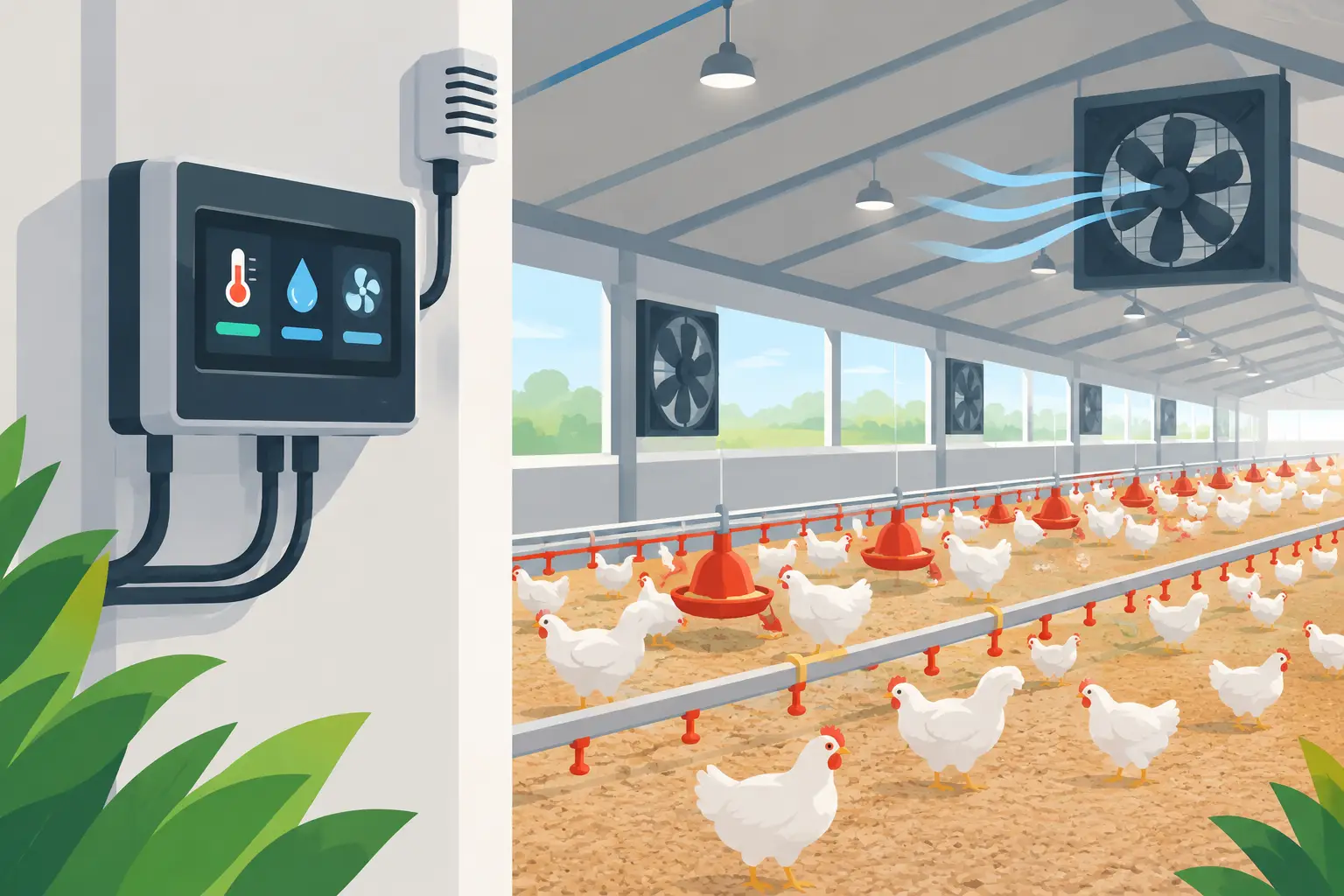
Climate Controllers for Better Poultry Houses
A poultry house can look calm while the environment is moving in the wrong direction. A fan stage may be late, inlet pressure may be unstable, or rising CO2 may reduce air quality before birds show obvious signs. Climate controllers turn those changing conditions into measured control actions, giving producers a practical way to protect bird comfort, feed conversion, growth, and house performance.
For commercial poultry and pig production, climate control is not a single thermostat function. It is the coordinated management of ventilation, heating, cooling, humidity, static pressure, lighting, alarms, and sensor data. The right controller provides a clear operating center for that work, whether a farm manages one house or an entire complex.
What Climate Controllers Must Control
A livestock house contains several systems that affect one another. Increasing ventilation can improve air quality but lower house temperature. Adding heat can maintain setpoint but increase operating cost. Reducing fan speed can preserve warmth, yet insufficient minimum ventilation can allow moisture, ammonia, and CO2 to build up.
A capable controller manages these relationships through programmed setpoints, curves, stages, and sensor feedback. Rather than requiring an operator to manually react to every weather change, the controller adjusts connected equipment according to the actual conditions inside the house.
For poultry applications, that commonly includes minimum ventilation fans, variable-speed fans, tunnel fans, air inlets, heaters, cooling pads, circulation fans, lighting, and alarm outputs. In pig barns, the same control principles apply, although the ventilation strategy, heating demand, and animal requirements may differ by room, production phase, and stocking density.
The goal is not to run more equipment than necessary. It is to run the correct equipment at the correct time. That distinction affects energy use, component life, and the consistency of the environment delivered to the flock or herd.
Climate Controllers Need Accurate Inputs
Control quality depends on sensor quality and sensor placement. A controller can only respond to the conditions it measures. If a temperature sensor is positioned near a heater, inlet, fan discharge, or direct sunlight, it may represent a local condition rather than the environment experienced by the animals.
Temperature remains the primary control input, but it is not sufficient by itself. Humidity sensors help identify excess moisture that can lead to wet litter, poor litter condition, and greater heating demand. CO2 sensors provide visibility into ventilation performance, especially during cold-weather minimum ventilation. Static pressure sensors confirm whether inlet operation is creating the pressure needed to direct incoming air across the ceiling before it reaches the birds.
These measurements are most useful when treated as part of one control strategy. For example, if house temperature is at target but CO2 is elevated, reducing ventilation simply to hold temperature can be the wrong decision. The system may need to maintain or increase minimum ventilation while using heat to preserve the required temperature.
Sensor maintenance also matters. A control system should be checked regularly for calibration, physical damage, contamination, loose wiring, and communication errors. Producers should review readings against independent instruments when a value appears unrealistic. Reliable automation begins with reliable field data.
Ventilation Control Is More Than Fan Staging
Ventilation is often discussed as fan capacity, but fan capacity alone does not guarantee proper air exchange. Air must enter the house correctly, travel through the occupied zone as intended, and exit at a rate that meets the needs of the animals and the building.
During minimum ventilation, the controller may operate fans on timers or variable output to remove moisture and contaminants without chilling the birds. Inlets must open enough to maintain the intended static pressure and air throw. If inlets open too far, incoming cold air may drop directly onto the flock. If they do not open enough, fans can work against excessive restriction and air distribution becomes inconsistent.
As outside temperatures rise, climate controllers can progress through programmed fan stages and cooling functions. Variable-speed control is especially useful at the transition points between low and high ventilation demand because it avoids abrupt changes in airflow. In tunnel-ventilated poultry houses, the system must coordinate tunnel fans, inlet or tunnel door position, cooling pads, and temperature targets as conditions shift through the day.
There is no single ventilation program that fits every site. House dimensions, insulation, equipment layout, bird age, stocking density, regional weather, and production program all affect the required setup. Controllers should therefore be configurable, not limited to a fixed operating sequence.
Use Curves That Follow Animal Requirements
Birds do not need the same house conditions at placement, mid-grow, and market age. Young chicks require a tightly managed warm environment with carefully controlled minimum ventilation. As bird mass and heat production increase, ventilation demand changes. A control program that does not follow that progression forces managers to make frequent manual adjustments or accept uneven conditions.
Setpoint curves allow temperature, ventilation, lighting, and other operating targets to change by day of age. This gives the controller a planned path to follow while still allowing it to respond to real-time sensor readings. For broilers, pullets, turkeys, breeders, and layers, those curves should be based on the production program and verified against actual flock response.
Producers should avoid treating a programmed curve as permanent. Seasonal weather, equipment changes, bird genetics, litter condition, and house performance may require adjustment. The value of a modern controller is not that it eliminates management judgment. It gives the manager better control, clearer information, and faster response when judgment is required.
Alarms Protect the Time Between Inspections
A house environment can change quickly after a power failure, fan fault, heater issue, high-temperature event, water-related failure, or communication problem. Alarms are not an optional add-on to climate control. They are a critical layer of protection for animals, equipment, and production continuity.
Alarm strategy should address both absolute conditions and equipment performance. High and low temperature alarms are essential, but they should be supported by alarms for static pressure, CO2, humidity, sensor failure, fan feedback, and power status where applicable. A well-configured alarm system identifies the problem early enough for the farm team to act.
Alarm limits require careful setup. If thresholds are too tight, nuisance alarms can cause alert fatigue. If they are too broad, the system may not report an issue until house conditions have already moved beyond an acceptable range. Test alarms during commissioning and at regular intervals, including the communication path used for remote notifications.
Remote Access Should Support, Not Replace, House Checks
Remote access gives production managers a faster view of house status, especially across multiple farms or sites. From a phone, tablet, or computer, authorized users can review temperatures, ventilation activity, alarms, and operating status without waiting for the next scheduled visit.
That visibility is valuable when weather changes rapidly or when a site reports an alarm outside normal working hours. It also helps technical teams compare house performance, identify recurring faults, and support staff with accurate operating information.
Remote access does not eliminate the need for physical inspection. Walkthroughs still reveal equipment noise, water leaks, litter condition, inlet movement, airflow patterns, and bird behavior that a screen cannot fully show. The strongest operating model combines connected oversight with disciplined on-farm checks.
Build an Expandable Control Platform
Climate control works best when it is part of a connected farm management system. Environmental data becomes more useful when viewed alongside bird weights, feed use, silo inventory, water consumption, and production records. Changes in feed intake or bird weight can provide early context for an environmental issue, while climate trends can help explain a production result.
Agromatic's Columbus AGM platform is designed around this integrated approach, combining configurable house control with monitoring and expansion options. A farm should be able to add sensing, weighing, feed monitoring, or remote capabilities as operational needs change, without replacing the entire control architecture.
When selecting a controller, technical buyers should focus on more than the number of outputs. Consider the controller's I/O capacity, sensor compatibility, screen usability, language support, alarm options, remote connectivity, data access, and ability to support future expansion. A low initial equipment cost can become expensive if the system cannot adapt to a new house layout, additional sensors, or a changing production program.
The best climate control system is the one that gives the farm a dependable view of what is happening in every house, then acts consistently on a control strategy built for the animals inside it. Start with accurate sensors, verify every output during commissioning, and review the data often enough to improve the next flock rather than merely react to the current one.


Comments