

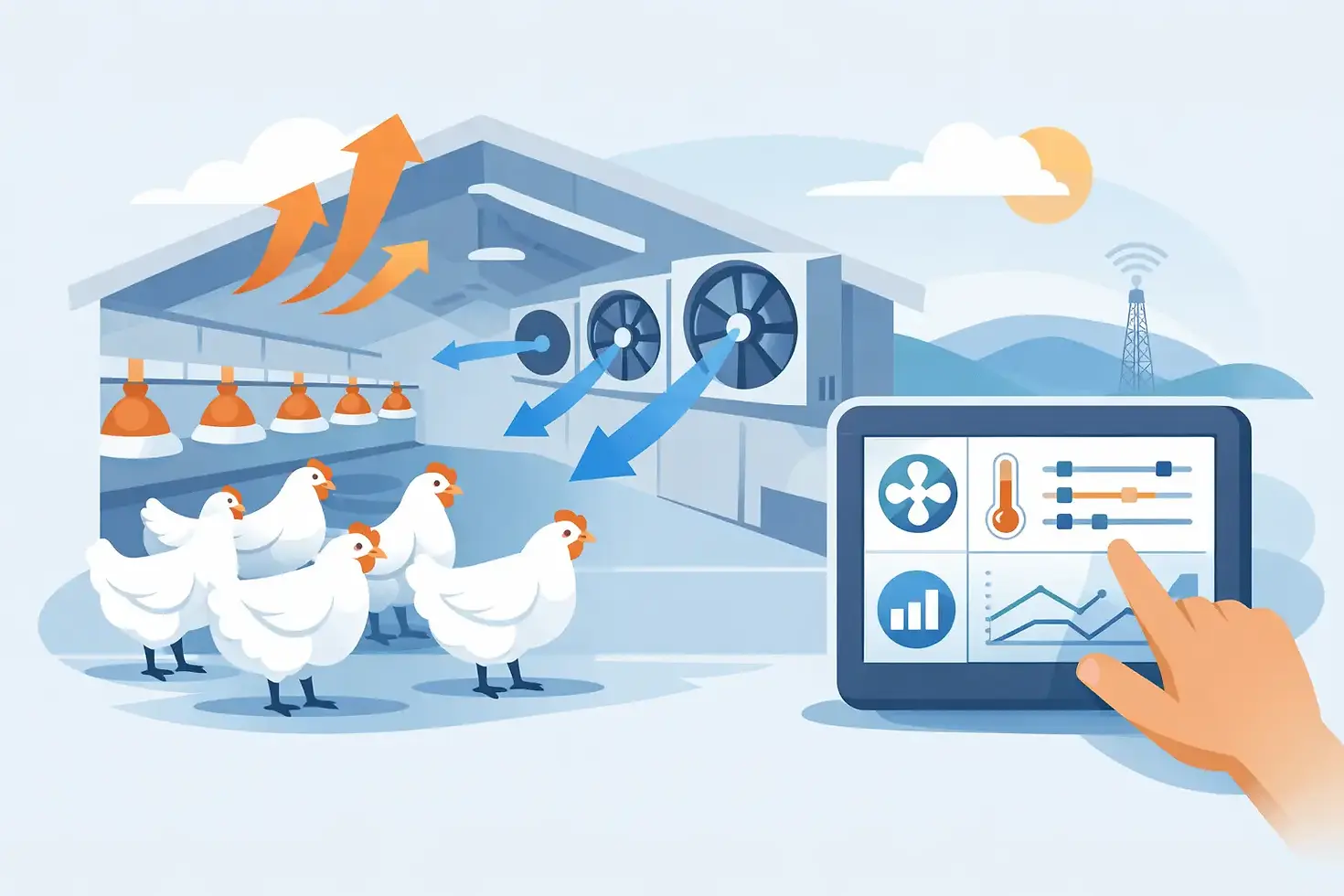
Broiler Ventilation Control System Basics
A broiler house rarely fails all at once. More often, performance slips in small ways first - wet litter along one wall, birds avoiding a section of the building, higher fuel use during mild weather, uneven weights at pickup, or ammonia complaints that show up before the flock reaches target age. In most cases, the broiler ventilation control system sits at the center of that problem.
For commercial producers, ventilation is not just about moving air. It is about controlling heat loss, moisture removal, oxygen supply, carbon dioxide, static pressure, and bird-level comfort in a building that changes every day as bird mass, outside weather, and equipment load change. A control system that cannot keep those variables aligned will push costs up and flock results down.
What a broiler ventilation control system actually does
At a practical level, a broiler ventilation control system coordinates fans, inlets, heaters, sensors, and alarm logic so the house reacts correctly to real conditions rather than fixed assumptions. That sounds straightforward, but the value is in how those devices work together.
A house can have enough fan capacity on paper and still ventilate poorly if inlet opening is wrong, static pressure is unstable, sensor placement is weak, or staging is too aggressive. Good control is not only a matter of turning fans on and off. It is a matter of controlling the air path, the timing, and the response speed so incoming air reaches the birds as intended.
That is why integrated climate controllers are increasingly preferred over isolated control components. When temperature, humidity, CO2, static pressure, and ventilation stages are managed in one platform, the controller can make coordinated decisions instead of forcing operators to balance separate systems manually.
Why precision matters in broiler production
Broilers are highly responsive to environmental variation. Small shifts in airspeed, floor moisture, or gas concentration can alter feed conversion, growth uniformity, and mortality. A ventilation system does not need to be dramatically wrong to create measurable losses.
During brooding, under-ventilation can allow excess moisture and CO2 to build, even when room temperature looks acceptable. During heavier bird weights, poor tunnel management can create hot spots or dead zones that reduce feed intake and stress the flock. In colder weather, aggressive minimum ventilation can protect air quality but waste fuel if inlet control and pressure are not managed correctly. The trade-off is always between air quality, heat retention, and bird comfort.
This is where advanced control earns its place. Instead of relying on a single temperature reading or manual timer settings, a modern controller uses multiple inputs to adjust house conditions with more accuracy. That reduces guesswork and gives the producer a more stable operating window.
Core components of a broiler ventilation control system
A complete system starts with the controller, but performance depends on the sensing and output layer around it. The controller is the decision engine. It receives data, applies programmed logic, and stages equipment accordingly.
Temperature sensors remain fundamental, but temperature alone is not enough for modern broiler management. Humidity sensors help determine whether the house is actually drying litter and removing moisture from respiration. CO2 sensors provide a direct reading of air exchange effectiveness, especially useful during minimum ventilation periods. Static pressure sensors verify whether inlets are creating the correct air throw across the ceiling rather than dropping cold air directly onto birds.
Fan outputs, inlet machines, heater control, cooling equipment, and alarm functions all need to be coordinated through that same logic. If fan staging increases without proper inlet response, the house may pull air incorrectly. If heating and ventilation are not balanced, the system may alternate between over-heating and over-ventilating, which wastes energy and creates unstable conditions.
A capable platform also needs operator usability. Touchscreen access, clear alarm handling, and simple parameter updates matter on a working farm. Control performance is only as good as the ability to configure and maintain it correctly.
How control strategy changes through the flock
One common mistake is treating ventilation as a fixed setup. A broiler ventilation control system should support different strategies as bird age and external conditions change.
In the early period, minimum ventilation is about air quality and moisture removal without chilling chicks. That requires careful timer logic, stable inlet opening, and enough pressure to mix incoming air before it reaches floor level. Sensor quality is especially important here because small reading errors can produce large comfort problems.
As bird density and heat production rise, the system shifts toward balancing moisture removal and sensible heat control. At this stage, fan staging and proportional response become more important. The goal is to avoid wide environmental swings while keeping litter condition under control.
In warm weather or at heavy weights, tunnel ventilation becomes the dominant strategy. Here, the system must coordinate large fan groups, inlet transition, cooling devices, and setpoint response without hesitation. Delays or poor staging can quickly push birds into heat stress. A controller that handles these transitions smoothly is not a luxury feature. It is a production safeguard.
Where many houses lose performance
Ventilation problems are often blamed on equipment size when the real issue is control quality. A house may have adequate fans and still perform below target because the control logic is too simple for the building.
A few examples are common. The first is over-reliance on one sensor location. If the controller reacts to a point that does not represent bird-level conditions, the whole system can drift. The second is poor static pressure management, which leads to short air throw and cold floor-level drafts. The third is manual adjustment fatigue. On multi-house farms, settings that depend on constant staff intervention usually become inconsistent.
Another weak point is lack of system integration. If bird weight data, feed behavior, and climate trends are not visible together, managers can miss early signals. Environmental stress often shows up in growth pattern and feed response before it becomes obvious as a ventilation complaint.
What to look for in a modern control platform
A serious broiler ventilation control system should be selected as a control platform, not just a box that switches fans. Flexibility matters because not every broiler house uses the same ventilation layout, heater type, or sensor package. The controller needs to fit the building rather than force the building into a rigid template.
Expandability is another practical requirement. Many farms start with a climate control need and later add weighing, feed monitoring, remote access, or additional sensing. Replacing the whole control architecture each time is costly and disruptive. A better approach is a platform that can grow with the operation.
Remote access is now part of operational control, not an extra feature. Production managers overseeing multiple sites need live visibility into alarms, setpoints, trends, and house status. Fast response to environmental deviation can protect flock performance and reduce after-hours risk.
This is where integrated systems such as the Columbus AGM controller approach are well aligned with modern broiler production. When climate control, sensor inputs, weighing, and feed-related functions are brought into one connected environment, the operator gains a clearer picture of what the house is doing and why.
Installation and setup still decide the outcome
Even the best controller cannot compensate for weak commissioning. Sensor placement, calibration, fan verification, inlet travel checks, and alarm testing all affect field performance. A technically strong system should make setup easier, but it still requires discipline.
It also pays to review settings by season. Minimum ventilation rates, target pressure ranges, and staging responses that work in January may not be right for spring turnaround conditions. Good control is not static. It needs periodic validation against actual flock results, fuel usage, litter condition, and mortality patterns.
That process should be data-based. If one house runs higher ammonia, burns more fuel, or produces less uniform weights than an adjacent house with the same bird program, the controller trend data should help narrow the cause quickly.
The real value is consistent control
For technical buyers, the question is not whether ventilation affects broiler performance. It does. The real question is whether the control system can hold conditions where they need to be across changing bird loads, weather swings, and labor variability.
A well-designed broiler ventilation control system gives the farm more than automation. It gives repeatability. That means fewer environment-driven surprises, better visibility into house behavior, and a more controlled path to flock performance. On a modern broiler operation, that is not just good engineering. It is a practical advantage worth building around.
The houses that perform most consistently are usually not the ones with the most equipment. They are the ones where sensing, control logic, and operator access work together without unnecessary complexity.


Comments